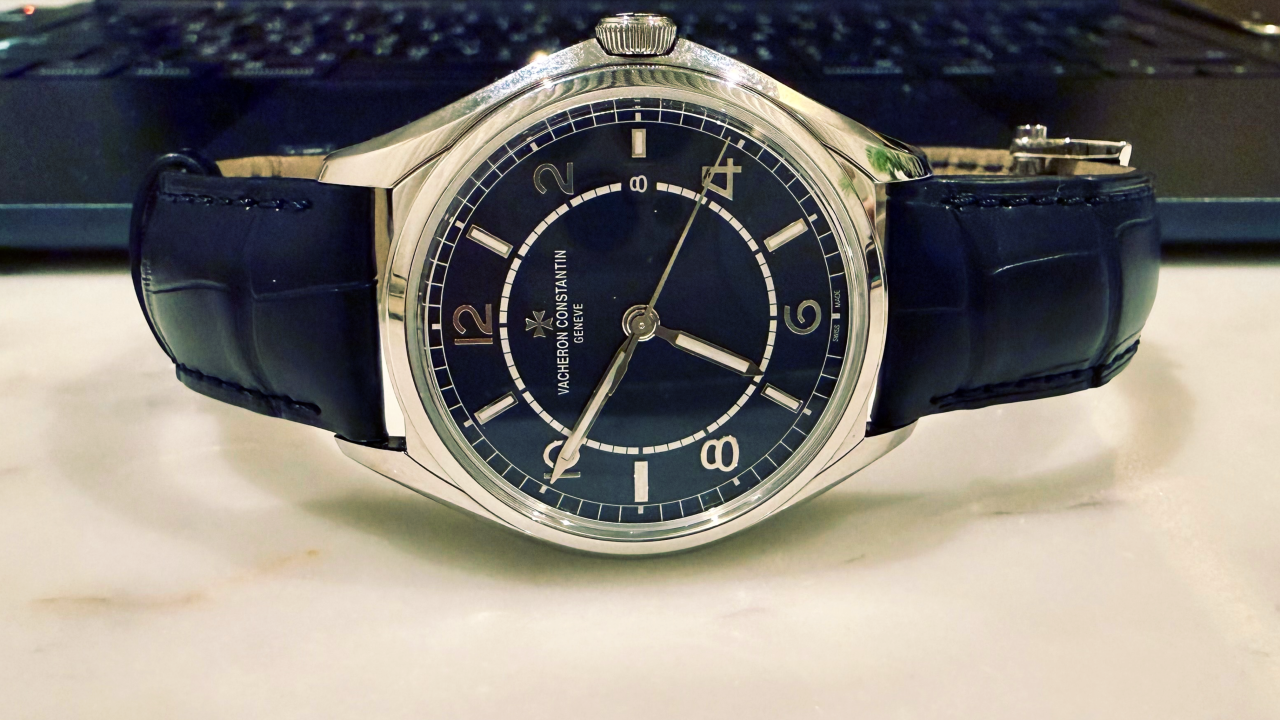
I cradle my Fiftysix Self-Winding (ref. 4600E/000A-B487) and feel the cool weight of history against my wrist.
This petrol-blue beauty is more than an accessory. It sits precisely at the intersection of past and present, crisis and continuity, East and West.
The gentle swell of its sapphire box crystal catches the light as I rotate the watch. In the polished steel case, the stepped sector dial, and the slow march of the date disc, there is something quietly philosophical about this watch.
Because the Fiftysix is not simply inspired by history.
It exists because history nearly ended.
And in that fragile moment, the story of this venerable Swiss manufacture briefly intersected with Saudi stewardship.
A Dial of Many Worlds
On the wrist, the Fiftysix’s sector dial anchors the entire design.
Two shades of petrol blue stretch across the dial. A sunburst exterior ring frames a softly opaline center, forming concentric layers that feel almost architectural. Applied gold hour markers alternate with Arabic numerals, catching light with restrained elegance.
The hands are slender, faceted, and lightly lumed. Functional, but refined.
Every element points back to a historical reference: the Vacheron Constantin ref. 6073 from 1956.
Yet the watch does not attempt to recreate the past.
It interprets it.
The box sapphire crystal, the 40mm steel case, and the contemporary proportions signal a modern watch meant for everyday life rather than the vitrines of a museum.
That balance is the essence of the Fiftysix. Nostalgia without imitation.
The Movement Beneath the Surface
Turn the watch over and the conversation shifts from design to mechanics.
Through the sapphire caseback beats the Calibre 1326, an automatic movement composed of 142 components and 25 jewels.
A 22-carat gold rotor swings slowly across the bridges, shaped in the form of the Maltese cross, the emblem Vacheron Constantin adopted in 1880. Geneva stripes ripple across the plates, blued screws punctuate the bridges, and the rotor’s weight quietly powers the mechanism with each movement of the wrist.
The movement runs at 4Hz and delivers approximately 48 hours of power reserve.
Some collectors note that the calibre is derived from a Richemont group manufacture rather than Vacheron Constantin’s traditional high horology calibres. That observation is fair.
But it also reveals the philosophy behind the Fiftysix.
This watch is not about exclusivity.
It is about accessibility to heritage.
And that is precisely why it exists.
A Brand That Almost Disappeared
To understand the Fiftysix, one must remember the 1970s.
The quartz crisis nearly erased Swiss mechanical watchmaking. Entire houses disappeared. Factories closed. Crafts that had survived for centuries suddenly looked obsolete.
Even Vacheron Constantin, the oldest watchmaker with uninterrupted production since 1755, stood dangerously close to collapse.
The response required reinvention.
In 1977, the maison introduced the Vacheron Constantin 222, a radical departure from traditional dress watches. Designed by the brilliant Jörg Hysek , the 222 embraced the emerging category of luxury steel sports watches.
Its integrated bracelet and distinctive case design marked a strategic pivot.
Two decades later, the DNA of that watch evolved into the Overseas collection in 1996.
Together, the 222 and the Overseas formed the foundation of Vacheron Constantin’s modern survival.
Without them, the brand we know today might not exist.
An Unexpected Saudi Chapter
Yet there is another, lesser-known chapter in this story.
In 1987, Ahmed Zaki Yamani acquired a significant minority stake in Vacheron Constantin.
His involvement is rarely discussed in mainstream horology writing, yet it reflects how the preservation of Swiss watchmaking has often depended on global collectors and patrons.
Yamani was one of the most influential figures in global energy markets. As Saudi Arabia’s long-serving oil minister and a central architect of OPEC’s influence during the 1970s, he was accustomed to operating at the intersection of geopolitics and economics.
But he was also a passionate collector of fine watches.
Following the death of Jacques Ketterer, a member of the family that had long stewarded Vacheron Constantin, the company faced a delicate transition.
Yamani’s investment provided stability during a fragile period.
He reportedly explored the possibility of acquiring full ownership of the company, but Swiss regulations concerning foreign ownership of companies holding significant real estate made such a transaction difficult.
Instead, he remained a supportive shareholder throughout the late 1980s and early 1990s.
In 1996, his stake was eventually sold to the Vendôme Luxury Group, which later became Richemont.
That transaction marked the beginning of Vacheron Constantin’s modern corporate era.
But for nearly a decade before that, the house’s continuity quietly intersected with Saudi patronage.
It is a story rarely mentioned in horology.
The Character of Yamani
Yamani himself was a remarkable figure.
In 1975, he survived a dramatic hostage crisis in Vienna when terrorists led by Carlos the Jackal stormed an OPEC meeting and abducted several ministers. The ordeal lasted days and captured global headlines.
Yet those who knew Yamani often described him as calm, measured, and deeply intellectual.
After leaving the Saudi government in 1986, he devoted much of his life to cultural preservation.
He founded a Heritage Foundation, dedicated to preserving and publishing rare Islamic manuscripts. He advised UNESCO and championed the protection of historical knowledge.
He also remained a devoted watch collector, particularly fascinated by minute repeaters and complicated mechanisms.
In 1992, Vacheron Constantin created Reference 1755, then the world’s thinnest minute repeater, a watch that reflected the same values Yamani admired: precision, restraint, and respect for tradition.
Between Worlds
When I look at my Fiftysix today, I see more than a watch.
I see a bridge.
Between 1956 and the present.
Between Swiss craftsmanship and global patrons.
Between crisis and continuity.
The dial reflects the past, the movement reflects modern pragmatism, and the brand itself reflects centuries of adaptation.
Heritage in watchmaking is often described as uninterrupted history.
But the truth is more complicated.
Heritage survives because, at critical moments, someone chooses to preserve it.
Sometimes that stewardship comes from within the valleys of Swiss watchmaking.
And sometimes, unexpectedly, it comes from far beyond them.
Heritage Is Endurance
The calm rhythm of the Fiftysix reminds me that continuity is rarely linear.
It is a sequence of interruptions, recoveries, and reinventions.
The beauty of this watch is that it carries those interruptions gracefully. It does not attempt to erase them.
Instead, it acknowledges them.
Each revolution of its gold rotor echoes centuries of survival.
And somewhere within that rhythm lies a quiet truth.
Even the oldest watchmaker in continuous production since 1755 did not endure alone.
At times, history needed unexpected stewards.
And for a brief chapter, one of them came from Saudi Arabia.
— Mohammed Almarwani, ACIArb, CEO, AllChrono