
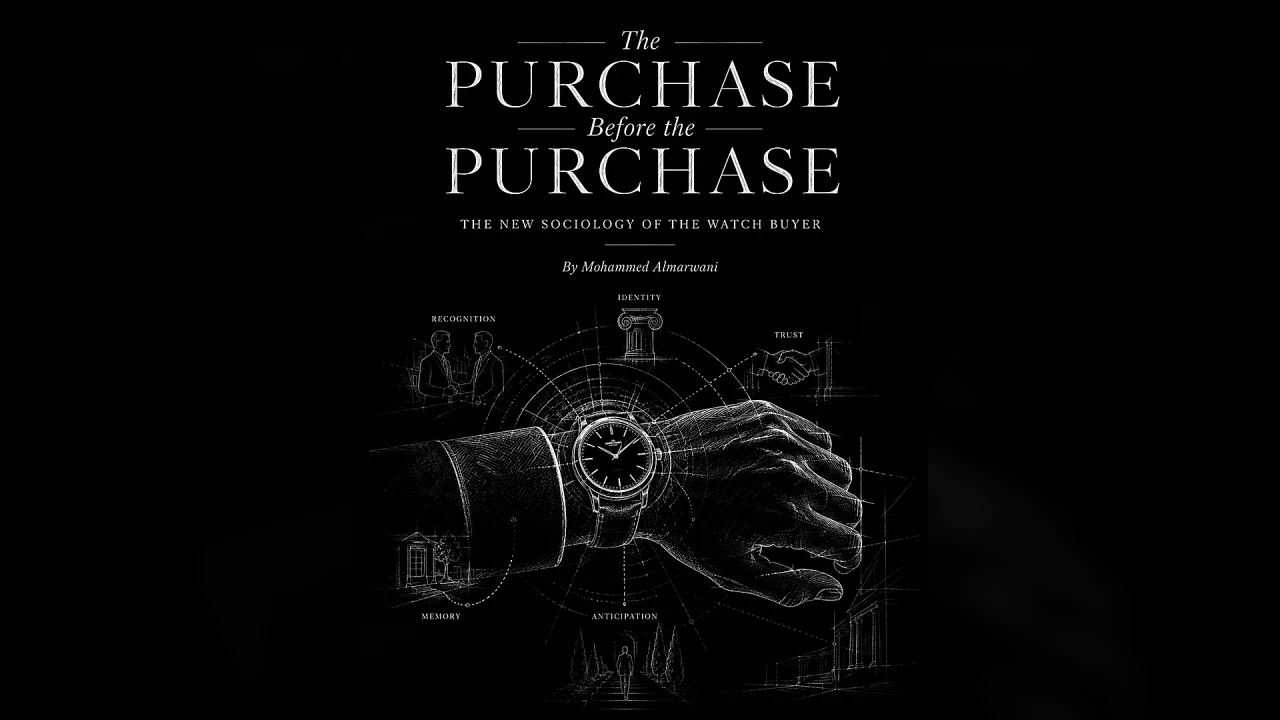
A watch is not bought only at the point of transaction. It is bought earlier, inside the buyer's imagination, where identity, recognition, trust, memory, and market confidence become attached to an object small enough to sit on the wrist and large enough to carry a society.
I. The Decision Before the Transaction
The watch industry often studies the buyer too late.
It studies the buyer at the moment when the decision already appears commercial. A reference has been selected. A price has become acceptable. A boutique relationship has been tested. A dealer has either earned confidence or lost it. A secondary-market listing has moved from curiosity to possibility. A wire transfer begins to feel real.
But the serious purchase begins before all of that.
It begins in the imagination of the buyer.
A person does not first buy a watch when money changes hands. The buyer first buys the version of life in which that watch belongs. The room in which it will be understood. The signal it will send without explanation. The memory it may one day carry. The recognition it may receive from those who know how to read it. The confidence that the object will still mean something when the market has moved elsewhere.
Only after that does the transaction happen.
This is the purchase before the purchase.
The phrase matters because it moves the watch market away from the shallow language of products and into the deeper language of human behavior. Watches are not merely bought because they are scarce, beautiful, expensive, mechanical, or branded. Those qualities matter, but they do not explain the whole event. A watch is bought because the buyer has already imagined a social, emotional, and cultural future for the object.
That future may be private. It may belong to a collector circle. It may belong to a family. It may belong to a boardroom, a city, a nation, a peer group, or a narrow culture of taste where only a few people can properly recognize what is being worn. But the buyer senses that world before the purchase is completed.
The invoice is not the beginning.
It is the confirmation.
II. The Death of Functional Time
The mechanical watch should have disappeared.
If function alone governed survival, it would have become a beautiful relic, admired by specialists and preserved by museums. Time is now everywhere. It is on phones, dashboards, laptops, kitchen appliances, airport screens, public transport systems, office walls, and digital devices carried by nearly every person on earth. Time has become free, ambient, and almost impossible to escape.
Yet the watch did not disappear.
This means its survival cannot be explained by timekeeping alone. The watch did not survive because modern life needed another way to know the hour. It survived because it changed function. It moved from measuring time to carrying meaning.
That change is not decorative. It is structural.
The modern watch has become one of the last objects through which a person can express status, taste, memory, discipline, reward, belonging, and restraint without having to state those things directly. It is close enough to the body to feel intimate and visible enough to become social. It remains functional enough to avoid appearing purely ornamental, yet symbolic enough to carry more than utility.
Recent consumer research supports the shift. One major industry study found that a strong majority of surveyed consumers still planned to buy a traditional watch for personal use, while the motivations differed sharply by generation. Older buyers were more likely to emphasize telling time. Younger buyers placed greater weight on appearance, self-reward, and identity-linked motivations.
The statistical point is not that function has vanished. It is that function has lost its monopoly. The younger buyer does not abandon the traditional watch. The younger buyer relocates its purpose.
The watch is no longer defended by necessity.
It is defended by meaning.
III. Recognition Is More Sophisticated Than Display
The laziest interpretation of luxury says people buy watches to show off.
Sometimes they do. Human beings are not innocent of display. But that explanation is too crude for the serious watch market, and it fails to explain the most interesting purchases.
Display wants to be seen by everyone. Recognition wants to be understood by the right people.
That distinction is central to the sociology of the wrist. A loud object seeks attention. A serious object often seeks legibility within a specific field of taste. The owner of a watch may not want universal recognition. In many cases, universal recognition is precisely what weakens the signal. The stronger object can speak more quietly because it does not need the entire room.
A yellow-gold Day-Date speaks one language. A Cartier Tank Louis speaks another. A Royal Oak, a Lange 1, a Grand Seiko, a Calatrava, a vintage Heuer, an FP Journe, a Rexhep Rexhepi, an old Submariner with the right aging, a Ming, or a small independent watch that most people will never identify: each object does not merely communicate expenditure.
Money is the least interesting reading.
The deeper signal is knowledge, restraint, access, memory, or a refusal of the obvious choice.
The best watches do not simply say, "I have."
They say, "I know."
This is why watches remain among the most sophisticated status objects in modern life. They are visible, but deniable. Public, but intimate. Technical, but emotional. Commercial, but cultural. They enter a room with the wearer, yet they do not require the spectacle of a car, a house, or a garment built for immediate recognition.
A watch can announce.
The more durable watch often converses.
IV. The Buyer Buys a Self
The purchase begins with a private question:
Who am I when this belongs to me?
That question explains more of the watch market than price charts alone ever can.
For one buyer, the watch is proof that a stage of life has arrived. A first serious achievement. A promotion. A marriage. A difficult year survived. A private victory that has no official ceremony. For another, the watch is continuity: a father remembered, a family line extended, a milestone made physical. For the collector, the object may complete a thought, correct a gap, clarify a period, or prove a movement from obvious desire toward informed judgment.
The wealthy buyer may not be buying wealth at all. Wealth may already be obvious. The purchase may instead be about restraint, rarity, cultural confidence, or the pleasure of being understood by only a few people at dinner.
The younger buyer may not want the same symbols that formed the previous generation's hierarchy. The choice may move toward design, proportion, vintage, smaller cases, Cartier, independents, neo-vintage, or watches whose social meaning is less blunt and more coded. Women collectors, design-led clients, Gulf buyers, Asian collectors, and independent-watch enthusiasts are no longer peripheral to the market's psychology. They are helping rewrite it.
This is not random taste.
It is identity under social pressure.
Recent secondary-market analysis has shown younger buyers moving more visibly toward dress watches, Cartier, smaller proportions, and design-led references. The numbers should not be read as a temporary style note only. They reveal a deeper movement. Younger buyers are forming their own grammar of recognition. Some are moving away from the brute dominance of steel sports watches and toward shape, elegance, proportion, and cultural fluency.
They are not merely buying watches.
They are buying a way to be read differently.
That is why every serious watch house should study the buyer before the buyer appears in the boutique.
By the time the client asks for the price, much of the decision has already happened.
The sale is late.
The meaning came first.
V. Liquidity Has Entered the Imagination
There was a time when watch buying could be explained more simply. A buyer liked a watch, bought it, wore it, and perhaps kept it for life. The market existed, but it did not sit so visibly inside the buyer's mind.
That world has changed.
The modern buyer may still speak romantically. The buyer may say, sincerely, that love matters more than resale. Many collectors dislike the language of speculation and reject the culture of flipping. Yet somewhere behind the romance, another calculation has entered.
Can this watch be sold if needed? Is the seller credible? Are the papers complete? Is the service history clear? Is the condition honest? Is the reference liquid? Is the price defensible? Will a future buyer trust what is being bought today?
Liquidity has entered the imagination.
This does not make every collector a trader. It makes the collector modern. The buyer now lives in a market where emotion and exit can no longer be separated cleanly. A person may buy from love, but love now asks for documentation. Desire wants beauty, but payment wants proof.
This is one of the great behavioral shifts in watches.
The buyer is emotional at the point of attraction and forensic at the point of commitment. A dial may create desire, but the warranty card still matters. A story may seduce, but the ownership chain must cohere. Patina may be beautiful, but damage cannot be allowed to disguise itself as romance. Rarity may attract, but opacity weakens confidence.
The pre-owned market accelerated this psychology. It gave buyers access, comparison, liquidity, and discovery. It also trained them to be more suspicious. Every watch now carries not only a price, but a shadow price. Every purchase carries not only pleasure, but a future question.
Can this object travel?
Not physically only. Can it travel through trust, through time, through ownership, through geography, through market scrutiny, through the judgment of the next informed person?
That is now part of the purchase.
VI. Trust Is the Hidden Luxury
The watch industry often treats trust as another word for authentication.
That is too narrow.
Authenticity is essential, but trust is larger than authenticity. A watch can be genuine and still be difficult to trust. The price may be misleading. The condition may be misrepresented. The history may be incomplete. The seller may be careless. The ownership chain may be unclear. The watch may be real, but the transaction may still feel unsafe.
Trust is not only a certificate.
It is the atmosphere of confidence around the object.
In serious markets, trust becomes infrastructure. It allows the buyer to act, the seller to release, the dealer to stand behind a representation, the collector to preserve credibility, and the object to move between cities, currencies, jurisdictions, families, and generations without losing its authority.
A watch without trust remains a thing. A watch with trust becomes transferable memory.
The buyer understands this even without using institutional language. The buyer feels it in the pause before sending funds. In the discomfort created by an evasive seller. In the unease of a listing that looks too perfect. In the difference between a watch that has papers and a watch whose story actually makes sense.
Modern watch buying is therefore not only aesthetic.
It is moral and forensic.
The buyer is asking whether the object deserves belief.
VII. The New Geography of Confidence
Distribution is not neutral. It shapes behavior.
A mono-brand boutique can create ceremony, scarcity, and controlled intimacy. It can make the client feel chosen. It can preserve the narrative discipline of the maison. For certain brands, clients, and purchases, that atmosphere remains powerful.
But it is not the whole market.
The modern buyer also wants comparison, context, optionality, and market intelligence. The buyer wants to test one brand against another, one era against another, one case shape against another, one condition against another. The buyer wants advice that is not always trapped inside a single brand's commercial script.
Recent industry research shows this tension clearly. Consumers continue to value in-store purchase experiences, but many also prefer multi-brand environments where they can compare, learn, and move across maisons. Younger buyers also show strong interest in pre-owned watches, reinforcing the importance of optionality, trust, and market context.
This should not be read as hostility toward brands.
It is a demand for a wider field of confidence.
The buyer wants the romance of the maison, but also the discipline of the market. Brand authority still matters, but brand confinement is less persuasive than it once was. Ceremony remains valuable, but ceremony without transparency begins to feel like theater. Scarcity can create desire, but unexplained scarcity can also create resentment.
The serious buyer is no longer satisfied by the object alone. The buyer wants the conditions around the object to be credible.
That is the new geography of confidence. It is not purely physical, digital, boutique, dealer, platform, auction house, or private network. It exists wherever desire and trust can be placed in the same room.
VIII. Hype Was Never the Market
The last decade taught the industry a dangerous lesson.
It confused heat with depth.
Waiting lists, market premiums, celebrity exposure, social-media repetition, auction theater, and speculative buying made certain watches appear culturally invincible. Some were important. Some were merely inflated. The difference became harder to see during the fever.
Hype can move attention faster than taste can mature. It can raise a price before authority has formed. It can make an object visible before it has been properly understood. But the market eventually asks a colder question.
What remains when the noise leaves?
That question is now moving through the watch world. It can be seen in the normalization of previously inflated references, the renewed seriousness around dress watches, the return of smaller proportions, the growth of interest in independent watchmaking, and the exhaustion with lazy limited editions or collaborations that borrow sacred codes without protecting the authority beneath them.
The buyer who has lived through hype becomes harder to fool.
This does not mean the buyer becomes less emotional. The watch buyer has not become less romantic. The buyer has become more demanding about what deserves romance.
That distinction matters. It explains why some objects survive correction while others disappear with the cycle. It explains why certain maisons retain authority even when prices soften. It explains why some independents gain cultural seriousness without mass recognition. It explains why a brand can sell a watch and still weaken the symbol beneath it.
Taste returns after hype because judgment returns after intoxication.
Taste is not decoration. It is the ability to know which object will still carry meaning after attention has moved elsewhere.
IX. The Luxury Consumer Is More Skeptical Now
The watch buyer is part of a wider luxury reset.
Luxury customers are not disappearing, but many are becoming less obedient. They are questioning price increases. They are comparing value. They are moving between new and pre-owned. They are spending on experiences, smaller indulgences, and objects with stronger personal meaning. They are less willing to reward brands that confuse pricing power with cultural authority.
This matters for watches because a luxury slowdown does not affect all objects equally. The weaker object becomes harder to justify. The cynical price increase becomes more exposed. The lazy novelty becomes less convincing. The brand that relied only on scarcity begins to look fragile when desire cools.
But the meaningful object can survive.
A watch with design authority, technical seriousness, emotional relevance, cultural memory, and trusted market behavior does not depend only on the generosity of the cycle. It has reasons to endure.
That may make the next period of the watch industry healthier than the last, even if it is less euphoric.
It will punish noise.
It will reward coherence.
X. Geography Is Not Only a Sales Map
The watch market is not only changing by generation. It is changing by geography.
For too long, geography has been treated as a sales map. This market is up. That market is down. This region prefers steel. That region prefers gold. This city likes complications. That city likes icons.
But geography is not only distribution.
Geography is culture, wealth formation, tourism, gifting practice, currency confidence, regulation, family structure, climate, public visibility, and the social life of objects. A watch in Geneva is not socially identical to the same watch in Riyadh, Dubai, Seoul, Tokyo, London, New York, Singapore, or Hong Kong. The object may be the same, but the room around it changes. So does the meaning.
Recent Swiss export data shows this unevenness clearly: the global picture has been softer, but regional performance is not uniform. Some mature markets have weakened while selected markets in the Gulf and Asia have shown resilience or growth. This should not be treated as a footnote.
It tells us that demand is not merely weakening or strengthening. It is relocating, fragmenting, and becoming more culturally specific. Some markets are exhausted by luxury inflation. Others are entering the category with new wealth, new taste, and new codes of recognition. Some cities consume watches as heritage objects. Others as arrival objects. Others as design objects. Others as portable credibility.
There is no universal watch buyer anymore, if there ever was one.
There are buyer cultures.
XI. The Watch as Portable Society
A watch is small, but it carries a society.
It carries the society of the maison that made it, the collectors who interpret it, the dealers who circulate it, the auction rooms that validate it, the families that inherit it, the cities that recognize it, the online communities that accelerate or damage its reputation, and the future buyers who may one day decide whether it still deserves belief.
This is why a watch is never only an object.
It is a portable social institution.
That may sound large for something worn on the wrist, but the market proves it every day. A small change in dial text can alter value. A missing paper can weaken confidence. A discontinued reference can become more meaningful than a current one. A celebrity photograph can accelerate desire. A brand misstep can damage the aura of an icon. A respected collector can move attention toward a forgotten reference. A cultural shift toward elegance can revive case shapes once treated as old-fashioned.
The watch is small.
The society around it is not.
This is the discipline the industry must recover: never mistake the size of the object for the size of the behavior.
XII. What the Modern Buyer Now Demands
The modern buyer does not merely demand product.
The modern buyer demands coherence.
The object must make sense. The price must make sense. The story must make sense. The condition must make sense. The channel must make sense. The experience must make sense. The brand's behavior must make sense.
This is why the next phase of the watch industry cannot be won by marketing alone. It will require a deeper respect for the buyer's intelligence. The buyer wants romance, but not manipulation. Scarcity, but not humiliation. Access, but not opacity. Heritage, but not lazy nostalgia. Modernity, but not gimmickry. Liquidity, but not the vulgarity of pure speculation. Trust, but not trust reduced to a slogan.
A serious buyer can forgive price.
The buyer is less willing to forgive emptiness.
This is the real consequence of the purchase before the purchase. The industry must stop imagining the buyer as a person who begins at the counter. The buyer begins earlier, in a private negotiation between identity, desire, recognition, evidence, and confidence. The commercial process only inherits what the imagination has already prepared.
The strongest brands, dealers, auction houses, platforms, and independents of the next century will not be those that merely place watches in front of buyers. They will be those that understand why the buyer was prepared to believe in the object before the object was bought.
XIII. The Earlier Decision
The future of the watch industry belongs to those who understand the earlier decision.
The moment when an object becomes a possible identity.
The moment when beauty asks for proof.
The moment when taste separates itself from noise.
The moment when trust decides whether desire can become transaction.
The watch survived because time became too common to matter by itself. Meaning did not. Recognition did not. Memory did not. The human need to be understood without speaking did not.
That is why the wrist remains important.
It is one of the last places where a person can carry meaning in public without announcing it.
And the real purchase, the one that matters most, begins before the watch is ever bought.
— Mohammed Almarwani, ACIArb, CEO, AllChrono
Evidence base: Deloitte Swiss Watch Industry Study 2025; Bain & Company Luxury Study 2025; Federation of the Swiss Watch Industry export data; Chrono24/Fratello H1 2025 Secondary Watch Market Report.