
It returned to profitability.
Those are not the same thing.
By the mid-1990s, mechanical watches were commercially fashionable again. Heritage was being rediscovered. Marketing was becoming sophisticated.
But something far more fragile had been lost during the quartz years:
The capacity to build true movements at the highest level.
Many brands survived by assembling. Some survived by storytelling. A few chose a more difficult path.
They chose to build.
Among them was Chopard
The Decision That Carried Risk
In 1996, when most houses were content sourcing reliable calibers, Karl-Friedrich Scheufele invested in creating a manufacture in Fleurier from the ground up.
Not an upgraded supplier network. Not a refined finishing workshop. A manufacture.
The first L.U.C movement, the 1.96, was not loud. It did not need to be.
Micro-rotor. Twin stacked barrels. Chronometer precision. Proportions that reflected confidence rather than experimentation.
Watchmakers understood immediately what this meant.
Chopard had crossed a line.
It was no longer assembling watches.
It was engineering them.
The Architecture That Endured
The Chopard L.U.C XPS is not important because of its dial.
It is important because it carries that architecture forward without distortion.
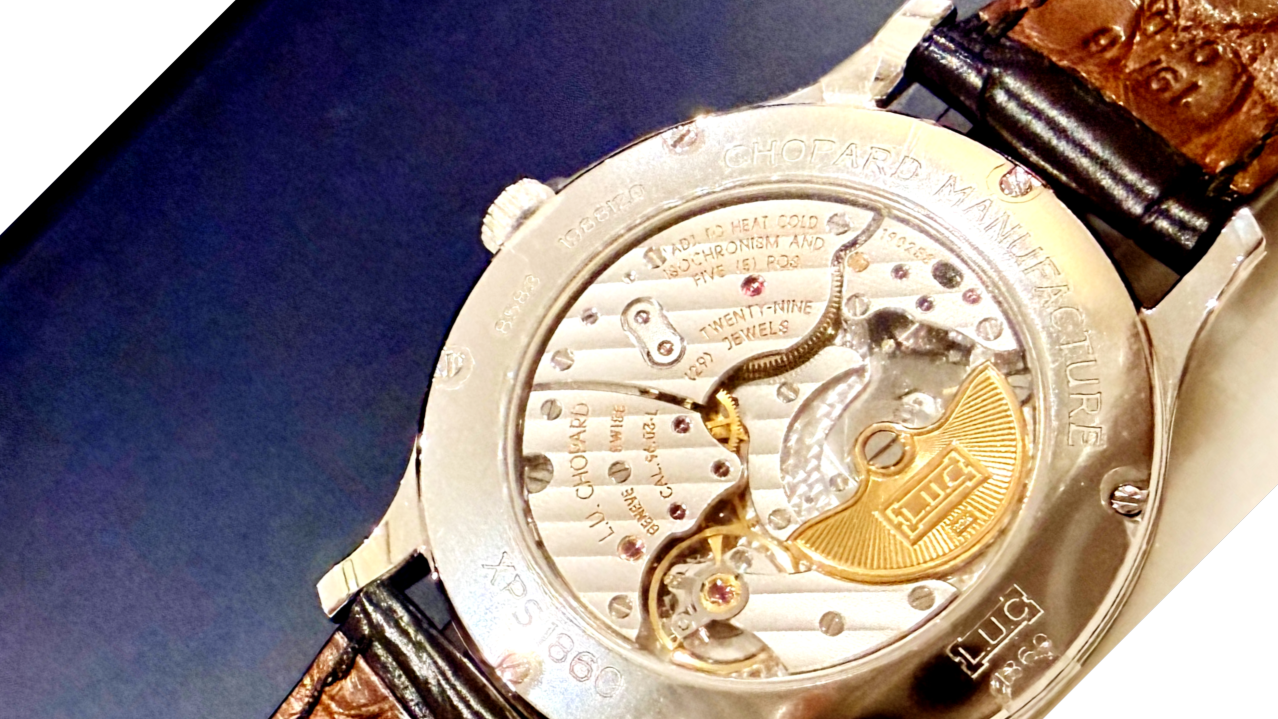
Inside sits the evolved Caliber 96 family.
The micro-rotor is not decorative minimalism. It is structural efficiency. It requires power transmission to be solved with discipline, not mass.
The twin barrels are not marketing. They are mechanical strategy, preserving autonomy without compromising thinness.
This philosophy sits closer to the micro-rotor tradition exemplified by the Patek Philippe Calatrava than to the vast majority of modern automatic dress watches.
But unlike Patek, Chopard rarely insists on reverence.
It assumes you will notice, or you will not.
The Strength of Restraint
Steel case. Slim profile. Small seconds balanced at six. A date that integrates rather than interrupts.
Nothing here seeks applause.
And that is precisely why it ages well.
Complicated watches often represent their era. Proportioned watches transcend it.
The XPS is not trying to be contemporary.
It is trying to be correct.
That difference becomes visible only with time.
The Market and the Misconception
Markets move on perception.
The hierarchy of brands was largely formed before L.U.C existed. Perception lags behind capability.
Yet the L.U.C division later stood alongside Parmigiani Fleurier and Bovet in establishing the Fleurier Quality Foundation, a measurable commitment to manufacturing integrity.
That was not a branding alliance.
It was a declaration of standards.
Standards outlive slogans.
Why It Stays in My Collection
Over time, I have realized I am less interested in spectacle and more interested in structure.
Industrial engineering in one piece. Independent finishing in another. Manufacture revival in this one.
The L.U.C XPS represents something I respect deeply.
The choice to invest in infrastructure when marketing would have been easier.
In business, that decision is rare.
It is also the only decision that creates longevity.
This watch does not shout. It does not compete for wrist presence. It does not ask to be admired.
It simply exists as evidence that after quartz, someone chose to build.
And in horology, as in institutions, those who build quietly tend to be remembered long after those who merely assemble are forgotten.
Authority is not inherited. It is engineered.
— Mohammed Almarwani, ACIArb, CEO, AllChrono