
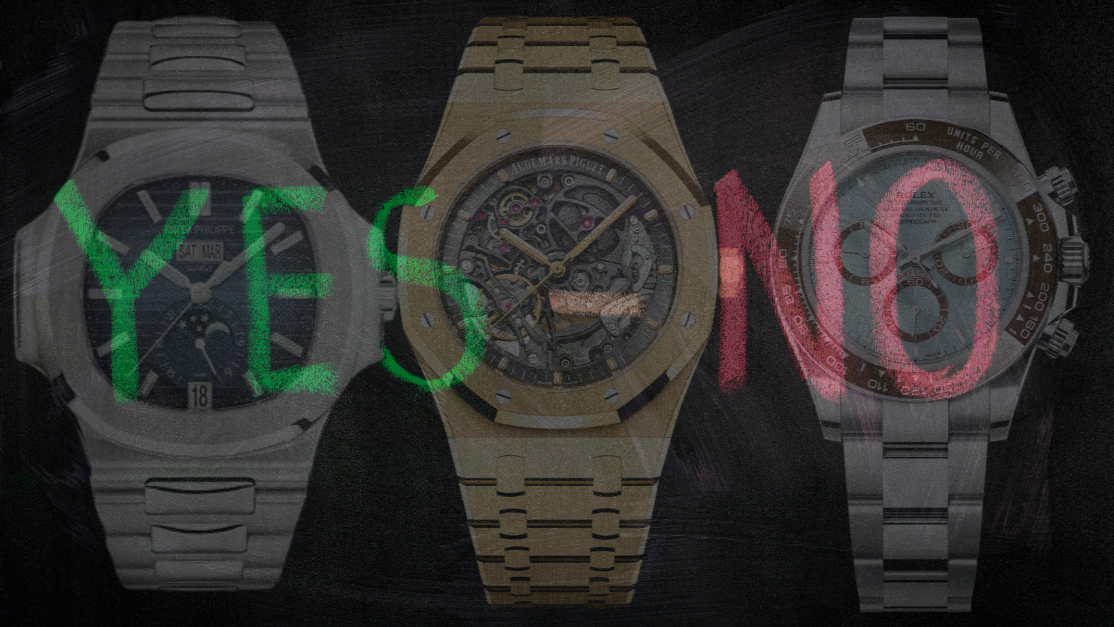
Here is the answer you came here for... it depends.
I know. I hate that answer too.
But it is the most honest thing anyone in this market will ever tell you, and everything after this explains exactly what "it depends" actually means.
What the Naysayers Say
The critics have a whole vocabulary for it. Watch flipping. Speculation. Veblen arbitrage. Status chasing dressed up as portfolio strategy. Their core argument is simple: a watch is a depreciating consumer good, not a financial instrument. Real investments live in brokerage accounts and index funds. Not on wrists.
And they are not entirely wrong.
Walk into a boutique tomorrow, pick up the first Limited Edition Breitling that catches your eye, and expect it to appreciate. That “investment” turns into an expensive lesson. But don't think the grey market or the secondary market automatically saves you either.
It's easy to overpay on a grey market piece that's being advertised solely against its MSRP.
Buy a secondary market watch chasing hype on a model that already peaked, and the result is the same.
The naysayers are describing that buyer. The problem is, they think that buyer represents everyone in this market.
They also tend to share one thing in common. They have never transacted with real market understanding, at any level. Retail, grey, or secondary. When their only frame of reference is information without action, of course it looks like a sunk cost. Because for them, it is.
What Actually Happens at Depreciation
Here is where the conversation changes.
Nearly every watch depreciates the moment it leaves the AD and the retail premium disappears. That difference between retail and secondary market price is a loss for some, and an opportunity for others.
Buy at that depreciation point with the right model, at the right price, with a clear understanding of why it’s priced where it is, and the watch becomes something different. It does not automatically become an investment. But it is defensible. If you ever need to sell, and people do, even the ones who swore they never would, you are not liquidating at a 40% haircut. You are transacting at a fair market price, or close to it.
That is buying smart.
Buying What You Like Over Everything Else
Before anything else gets said about markets, liquidity, or scarcity premiums, if you are buying a watch to wear, buy what you like. Full stop.
I will never advise you to buy something you don’t want on your wrist. Other dealers shouldn’t either.
Buy what you like. Wear it. Enjoy it. The market context matters when it is time to transact, not when it is time to choose what you like.
Where People Get This Wrong
Most people's opinion of the watch market is a reflection of themselves, not the asset.
Someone who has never owned a luxury watch looks at a Rolex and sees a brand name. An art dealer sees scarcity. An exotic car collector sees demand curve dynamics. A fund manager sees a liquid alternative asset with low correlation to public markets.
The difference is the lens being used to look at the watch.
Luxury exists because not everyone can have it. Resale value isn’t a bonus feature of luxury goods, it is the mechanism that makes them luxury in the first place.
If everyone could grab it, it would not be desired. The resale economy is what puts it there.
Lower-cost pieces have little to no resale traction. But when you move into genuine luxury, models with waitlists, references trading above retail a decade after release, independent brands with limited production, something different is happening.
There is a reason for it. The market is pricing information most buyers do not have.
The Secondary Market Is Where the Opportunity Lives
Dealers in this market treat it like an active trading floor. They understand movements, material values, brand trajectories, hype cycles, and supply constraints.
They are buying on informed expertise and selling to buyers who lack it.
The secondary market is where collectors can close the information gap and transact on their own terms. That is where I tell people to buy. Not at retail. Not at the AD. On the secondary market, where you get the most watch for your money and you enter with the depreciation already priced in.
That market is still underinstitutionalized and most people are not comfortable navigating it yet. That is why there is opportunity.
This will change within the next few years.
On Scarcity, Rarity, and What Actually Holds Value
Rolex. Patek Philippe. FP Journe. The independent market.
These brand names represent constrained supply, long-term demand, and collector communities that do not disappear when trends shift. FP Journe models are increasingly waitlisted and certain Rolex references have traded above retail for years showing structural stability.
The same psychology driving the trading card market, the art market,or the vintage car market applies here.
The ability to own something rare, to say this is in my collection, carries real economic weight.
The watch market has that same engine underneath it.
Gold also matters more than people realize. A gold Day-Date has gained roughly $7,000 in value over the past year from gold price movement alone.
A Panerai Luminor in solid gold, purchased in 2023 for $12,500, the gold content of that watch alone has materially appreciated as gold prices have climbed.
In these cases, you are buying a wearable position in a commodity.
The Data
The Knight Frank Luxury Investment Index has tracked watches as one of the top-performing luxury asset classes over the past decade, outperforming most traditional asset categories in multiple reporting periods.
The Rolex market, specifically, has demonstrated consistent long-term appreciation on key references.
Morgan Stanley has cited the secondary watch market as a multi-billion dollar opportunity with accelerating transaction volume and increasing institutional interest.
These are financial analysts looking at the secondary market and describing what they see, not dealers convincing you to buy the hype.\
So. Are Watches an Investment?
As a blanket answer... no, absolutely not.
Bought with intent, at the right price, at the right time, in the right environment, with an understanding of why the market values it the way it does?
Yes. Completely.
The definition of an investment is straightforward - capital deployed with the expectation of return or preservation of value.
A Rolex Submariner bought on the secondary market at depreciation, held for five years, and sold at or above purchase price? That meets the definition.
A gold Day-Date that has tracked gold appreciation while being worn? That meets the definition.
An FP Journe reference bought before the brand's demand curve went vertical? That meets the definition.
The blanket dismissal of watches as investments is an information gap dressed up as superior financial advice.
Learn the market. Understand what you are buying. Buy smart.
If you don’t, then it depends.
— Christian Bruhn