
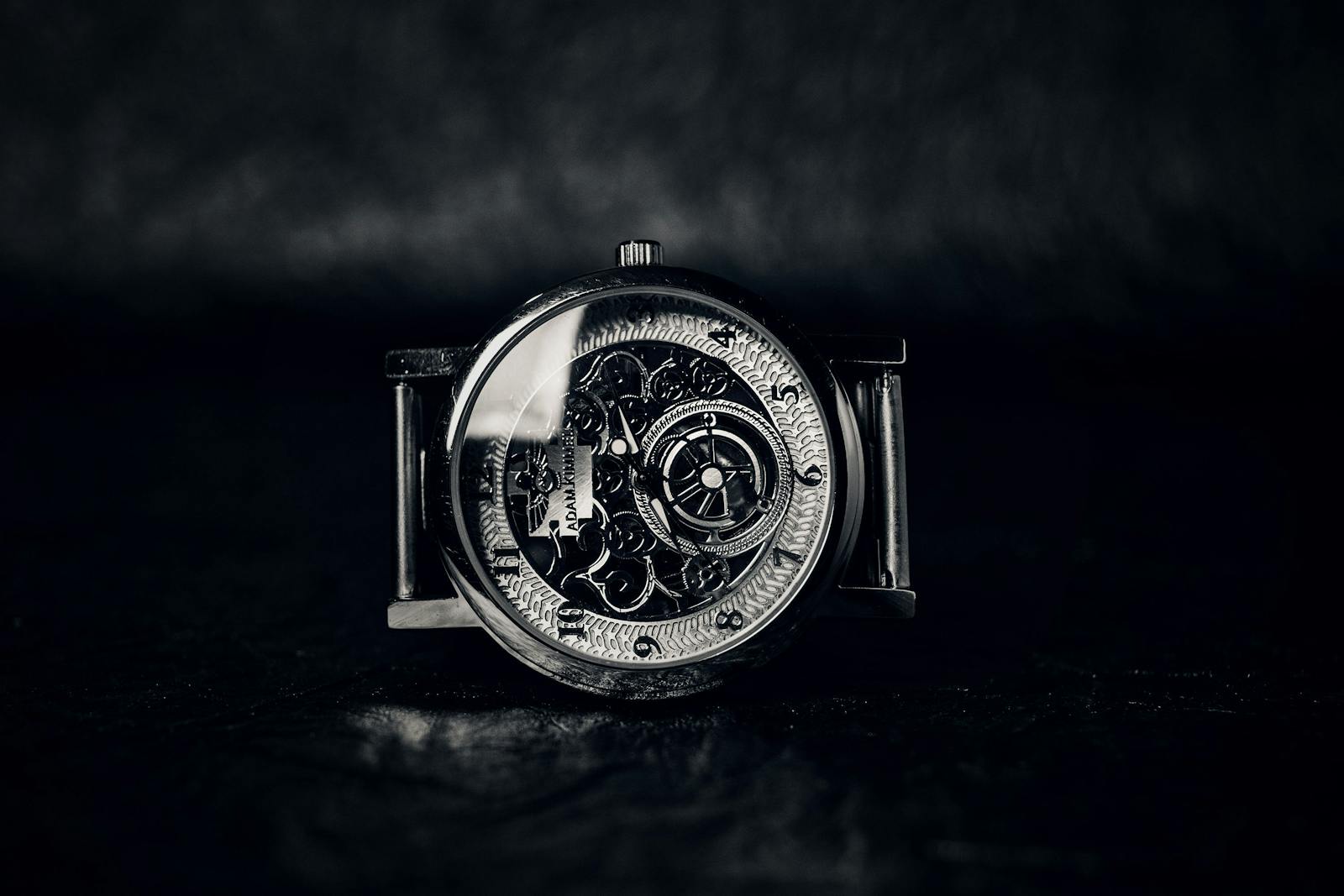
Authenticating a vintage Daytona is half optics and half archeology. The reference number on the case-back tells you which production years to expect; everything else has to match that period — the printing on the dial, the engraving on the bridges, the wear pattern on the bezel insert, the tone of the lume, the way the chronograph pushers feel under thumb pressure, and a dozen other small signals that a piece either does or does not align with its claimed history.
There is no single test. There is a checklist, and each item is a vote.
The reference window
The first thing that goes through the authenticator's mind when a Daytona lands on the desk is not "is this real?" — it is "is this exactly what it claims to be?" Those are different questions, and the difference is where most of the value premium lives.
A Daytona reference 6263 was produced from 1971 through roughly 1987. Within that window, the watch passed through at least four meaningful dial generations — early "Mark 1" with the now-famous Sigma marking; "Mark 2" with revised sub-dial proportions; "Mark 3" with cleaner printing and a slightly different chapter ring; and the late-period dials produced after 1981 that are common, well-documented, and command a meaningfully lower premium than the earlier marks. A piece sold as a "1971 Daytona reference 6263" carries a price that depends not just on the case-back stamp but on which dial generation is sitting on top of the calibre — and crucially, on whether that dial is the one that left the factory paired with that case.
The checklist is therefore comparative. We are not asking whether the piece in front of us is a Daytona. We are asking whether the calibre serial, the case-back stamp, the dial generation, the hand set, the bezel insert, and the bracelet endlinks all sit inside the same narrow production window. The answer is binary: they do or they don't.
The most common failure: mixing
A Paul Newman "exotic" dial commands a different premium than a standard Sigma dial of the same reference, even when both pieces are real Daytonas in real Rolex cases produced in the same factory in the same year. The exotic dial is rare. The standard dial is not. Both are correct for the reference. They are not interchangeable in market terms.
That price asymmetry creates the single most common failure mode in vintage Daytona authentication, and it is not counterfeiting. It is mixing: a genuine watch with a service-replacement dial that was correct for a Daytona, just not this Daytona. The dial is real Rolex. The case is real Rolex. The calibre is real Rolex. Every individual component would pass an honest inspection. The watch as assembled, however, is not original to itself.
Mixing happens in several different ways and the dossier has to be specific enough to distinguish them:
Service replacement. During an authorised Rolex service, the watchmaker may have replaced the original dial with a then-current factory part. This was particularly common during the 1980s when service centres were given period-correct replacement dials specifically for older references. A service-replacement dial is genuine Rolex but is not the dial that left the factory with the case. Honest dealers disclose this; the discount in the secondary market is consistent and well-known.
Frankenwatching. A piece assembled from components of multiple watches — case from one, dial from another, bracelet from a third. The components may all be real, but no actual factory watch ever existed in the configuration that the dealer is selling. Frankenwatches are the second-most-common form of vintage market failure after honest service replacements, and they are considerably harder to detect because every individual component will pass a component-level inspection.
Re-dialled pieces. A genuine watch with a dial that has been refinished — a worn original repainted to look factory-fresh, or in worse cases, a different dial design printed onto a blank substrate to mimic a more valuable variant. These are the cases where the difference between authentication and forgery work blurs, and they are where the deepest archive references and the highest-magnification optics actually matter.
The dossier has to be specific enough to expose all three. A passport that simply says "authentic Rolex Daytona reference 6263" is technically correct in every mixing case described above and useful in approximately none of them.
What goes on the record
For every Daytona that passes through our authentication desk, the dossier captures the following:
The optical record. High-resolution macro photography of the dial, the hands, the case-back, the bracelet endlinks, the crown, and any printing variations. The dial is photographed under controlled lighting — neutral, raking, and UV — because each light source surfaces different information. Original lume responds differently to UV than service-replacement lume; the difference is invisible under normal light and obvious under UV.
The mechanical record. The case-back is opened. The calibre is identified, dated to the calendar quarter, and cross-referenced against Rolex production logs that have been gradually accumulated by the watchmaker community over the last forty years. The bridges are inspected for the tool marks, factory engravings, and serial sequences that confirm the calibre has not been replaced. Where the calibre serial is consistent with the case-back stamp, the watch's mechanical identity is established.
The case record. Polishing history, lug shape relative to factory-original specifications, case-back interior markings, and crown thread integrity. Daytona cases of this era have been polished extensively over their lives, often multiple times. A piece that has been over-polished is not less authentic, but the case has lost lug definition, and the dossier reflects that. Cases that have been re-cased — moved into a non-original housing — are detectable from interior markings and case-thickness measurements.
The bracelet record. Original Daytona bracelets carry endlink stamps, clasp codes, and link counts that tie to specific production windows. A reference 6263 from 1971 with a 1985 service-replacement bracelet is not less of a watch, but the bracelet is dated separately and the dossier discloses the difference.
The provenance record. Service history, where available. Original boutique sale documentation, where it survives. Auction history, if the piece has previously been catalogued. The absence of a service record is itself information — a Daytona that surfaces in 2026 with no documented service history during a 55-year life either has been dramatically under-serviced or has been serviced through unauthorised channels, and both possibilities affect what the buyer is acquiring.
How AI will help, and where it won't (coming soon)
Roadmap item — not currently live. Authentication today is performed by our in-house horologists at the hubs; the AI assist described below is what we're building toward.
The authentication desk will use computer vision trained specifically on vintage Rolex references — a model that has seen tens of thousands of Daytona dials, can identify dial generation from a high-resolution macro within seconds, can flag printing variations that fall outside the documented production window, and can compare lume tone and fall-off pattern against the expected curve for a piece of the stated age.
What the AI will do well is pattern matching at scale. It will be faster than a human at saying "this dial's stroke weight is consistent with a 1974 Mark 2 production" or "the lume on this hand is brighter than would be consistent with this dial's age". It will catch mixing cases that a human authenticator would otherwise have to spend an hour cross-referencing manually.
What the AI will not do is sign off. The authentication will continue to carry a human horologist's name, and the human will remain responsible for the verdict. The AI's role is to make the human faster and more thorough — not to replace the judgment that, in the vintage market, is the actual product.
Why the dossier matters past the sale
A correctly assembled authentication record protects the buyer at the moment of purchase. That is the obvious value. The less obvious value is what the dossier does on the next sale, and the one after that.
When a watch trades hands, the legacy practice is to re-do the authentication work from scratch. The next dealer's authenticator looks at the piece, opens the case-back, inspects the calibre, checks the dial, and produces their own working assessment. The buyer pays for that assessment once. The next buyer pays for it again. The work is duplicative because the format of the previous authentication is not portable.
A digital provenance dossier — anchored on chain, signed by the original authenticator, durable beyond any single platform — changes that arithmetic. The next dealer can verify the existing record, confirm that nothing about the watch has changed since the last assessment, and either certify the continuity or document the changes. The buyer pays for the verification work once and inherits the record for the lifetime of the watch.
This is not a hypothetical mechanic. It is the difference between owning a watch with a documented life and owning a watch whose history has to be reconstructed every time it changes wrists. For a vintage Daytona, that difference is the entire reason the dossier exists.
What we're committed to
Every authentication that passes through our desk produces a dossier that names the authenticator, dates the work, captures the photographic and mechanical record, declares the mixing assessment explicitly, and travels with the watch from that point forward. It is the format of the assessment that makes it useful, not the conclusion. A clean dossier and a contested dossier are equally valuable to the next buyer — both tell them, accurately, what they are about to acquire.
The vintage Daytona market has run for sixty years on a model where every transaction starts the authentication clock from zero. We are betting that the next sixty years run on a model where the authentication clock keeps running, and the dossier is the watch.
— Leila Azimi, Senior Editor, Authentication