
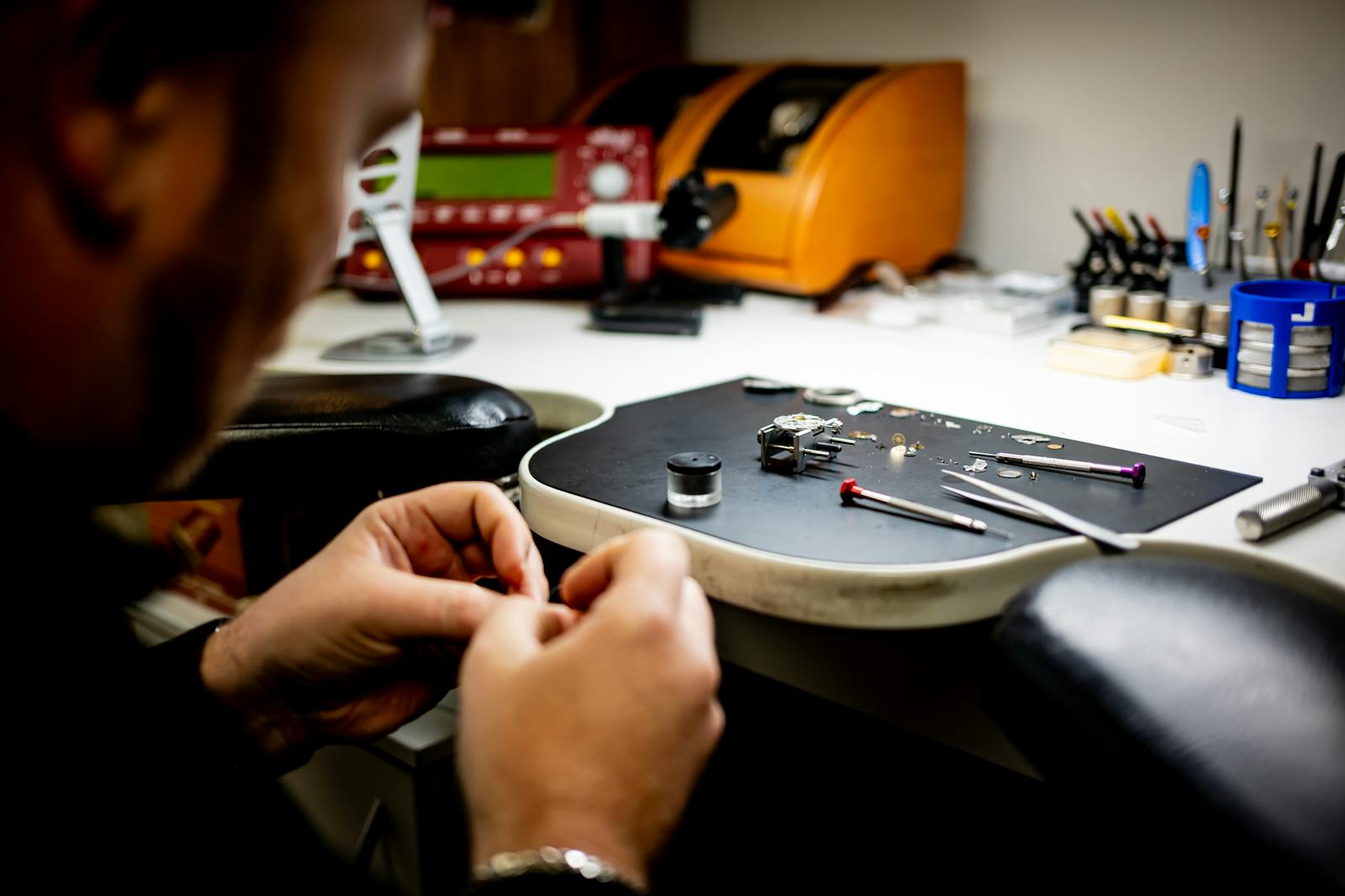
The address is unmarked. There is a buzzer at the gate, a discreet plaque visible only if you know to look for it, and a courtyard that opens into one of the most consequential watchmaking ateliers operating today. F.P. Journe's headquarters in Geneva — a building the company calls the Manufacture — is unusual not because of what it is, but because of what it isn't. It isn't a luxury group subsidiary. It isn't a private equity portfolio asset. It isn't owned, financially or creatively, by anyone other than the watchmaker whose initials sit on the dial.
That structural fact is the entire argument for paying attention to the brand, and it is the thread running through every reference Journe has shipped since the Tourbillon Souverain in 1999.
What "independent" actually means in 2026
The word independent has been overused in the watch world for a decade. Brands describe themselves as independent when they are wholly owned subsidiaries of larger groups but operated as semi-autonomous lines. Brands describe themselves as independent when their founder sits on a board controlled by financial backers. Brands describe themselves as independent when the only meaningful piece of their operation that they actually control is the marketing.
Independence in the structural sense — what the trade now calls fully independent to distinguish it from the marketing sense — is rare and getting rarer. It means three specific things:
1. Ownership. A single watchmaker, or a tightly held family, holds the equity. There is no group that can decide to discontinue a reference for portfolio reasons. There is no investor whose return horizon dictates production targets.
2. Movement design. The maker designs and produces its own movements in-house, end to end. Not movement assembly from purchased ébauches. Not modification of off-the-shelf calibres. The plates, bridges, escapement, gear train, and complications all originate inside the workshop.
3. Production scale. The annual output is small enough that every piece can pass through the hands of senior watchmakers — typically below 5,000 units a year, often below 1,000.
By that definition, the list of fully independent makers operating in Switzerland today is short. F.P. Journe is on every version of it. So is Philippe Dufour, Roger Smith (operating from the Isle of Man), De Bethune, MB&F, Akrivia, and a handful of others working at small scale. That is the entire field.
The Journe approach to a calibre
What separates Journe within that group is the design philosophy of his calibres — and the willingness to revisit fundamental questions that the rest of the industry treated as settled.
The Chronomètre à Résonance, introduced in 2000, is the cleanest example. The watch carries two independent escapements, each ticking on its own balance wheel, set close enough that the resonance of one balance influences the other. It is a phenomenon that watchmakers have noted in pendulum clocks for centuries, and that the Breguet workshop reportedly experimented with in pocket-watch form in the early nineteenth century. No serial-production wristwatch had ever attempted it. Journe shipped one, and the design has gone through three generations of refinement since.
The Octa calibre, which underpins most of Journe's contemporary references, was designed for a 120-hour power reserve in a movement no thicker than 5.7 millimetres. Watchmakers had been told for decades that the trade-off between power reserve and movement thickness was fixed. Journe re-engineered the going train, the mainspring chemistry, and the energy distribution between the two barrels, and produced a calibre that quietly broke the assumption.
The most recent reference, the Vagabondage III released in late 2025, carries a digital jumping seconds — a feature that has appeared in maybe a dozen watches in the entire history of the wristwatch. The complication is hidden in the movement architecture rather than displayed on the dial, which is a Journe signature: he treats engineering choices as private goods owned by the watch's wearer rather than as marketing assets.
The case rose-gold problem
In 2018, F.P. Journe quietly switched the cases of most of its references from white gold and platinum to a proprietary 18-karat rose-gold alloy. The published reason was aesthetic. The actual reason — confirmed by collectors who handled the same reference in both materials — was that the new alloy was harder, denser, and finished better than the standard rose gold the rest of the industry uses.
This is a small detail. It is also typical of how the workshop operates. Decisions get made because they improve the watch, and the marketing language gets bolted on afterwards. When industry analysts forecasted a softening for high-end independents during the 2024–2025 cycle, Journe's order book lengthened. The reason was the case material. Buyers had handled both versions and quietly decided that the rose-gold reference was a different kind of object.
This is what fully independent ownership produces in practice: the ability to make a multi-million-franc tooling decision because the founder believes it is the right decision, without having to win a portfolio review.
Why the secondary market reads independents differently
The trade reads watches from independent ateliers differently than watches from brand-owned makers, and the distinction has hardened in the last five years. There are three structural reasons:
Production scale. A reference produced in 200 units a year cannot be replaced by an inventory release. When demand exceeds supply, the only way to acquire one is on the secondary market. Journe's pricing reflects this: a Chronomètre Bleu in original platinum trades at multiples of its retail price, and the gap has widened consistently since 2019.
Founder risk-as-feature. When the value of a brand is structurally tied to a single watchmaker, there is a risk that the maker stops working. The market prices this risk in — and prices in the certainty that, once the maker stops, no further units of the existing references will ever be produced. The result is a secondary-market premium that operates like an option on continued scarcity.
Movement traceability. A Journe calibre is identifiable by its layout from across a room. The bridges are recognisable. The escapement is recognisable. The dial side gives away which calibre is underneath. This is unusual; most modern watch movements are visually generic, designed for industrial assembly rather than collector identification. Independents lean the other way — every component is a signature — and the signature is part of what trades.
What we look for at authentication
When a Journe reference passes through our authentication desk, the work runs differently than it does for a brand-produced piece. The reference library is smaller. The identifying features are more idiosyncratic. The questions are about which generation of a complication the movement carries, whether the case is original to the calibre, and whether the dial signature matches the production year stamped on the bridges.
That is the cost of independence. It is also the entire reason the watches matter.
A few months ago, Journe announced a successor plan that brings senior watchmakers from the atelier into formal succession roles. The announcement is significant because it removes one of the principal uncertainties about the brand's long horizon. It does not remove the central truth: that the references shipped from this workshop in the last twenty-five years will, in another twenty-five, still be the most identifiable independent watchmaking of their generation.
For collectors with a multi-decade view, that is the answer to why independents matter. They are the only watches in the global market whose value is structurally guaranteed not to be diluted by a brand strategy decision they cannot see.
— Henrik Sjögren, Editor-at-Large