
One of the more revealing tests of a luxury house is not whether it can attract admiration, but whether it can produce conviction.
Admiration is common in luxury. Conviction is rare. Admiration can be granted quickly, sometimes almost lazily, through prestige, familiarity, or inherited approval. Conviction is slower. It appears when a collector begins to feel that a brand is answerable to something deeper than market success. It appears when the object no longer feels like an item positioned for demand, but like the visible expression of an internal discipline.
That is why Grand Seiko is such an important case.
Its followers are not merely appreciative. They are often deeply committed. They return to the brand with unusual seriousness. They defend it without embarrassment. They study it, compare it, live with it, and remain attached to it even while knowing the great Swiss houses intimately. That kind of loyalty deserves a more exact explanation than the usual ones.
It is too shallow to say that Grand Seiko inspires loyalty simply because it is Japanese. It is too incomplete to say that the answer lies in technology alone. It is too commercial to reduce the matter to finishing, value, or differentiation within the market. All of these things participate in the answer, but none of them reaches the center of it.
The deeper reason Grand Seiko inspires loyalty is that it gives collectors the feeling of encountering a complete alternative.
Not novelty. Not eccentricity. Not a peripheral brand asking to be admitted into an established hierarchy.
A complete alternative.
That is a very rare achievement in modern luxury. Most brands, even very competent ones, operate within an already accepted language of legitimacy. They refine it. They decorate it. They market it more aggressively or more elegantly. But they remain inside the same inherited field of judgment. Grand Seiko does something more difficult. It creates the impression that it belongs to another order of seriousness altogether.
This is where difference becomes decisive.
People are often drawn to what is different, but they do not remain loyal to difference unless that difference proves capable of standing on its own authority. Novelty can attract curiosity. Unfamiliarity can provoke fascination. Even visual strangeness can produce temporary excitement. But none of that sustains devotion unless it is supported by an internal logic strong enough to survive prolonged scrutiny.
Grand Seiko survives scrutiny. More than that, it often strengthens under it.
The collector may approach Grand Seiko because it does not feel like the familiar script of watch prestige. The surfaces behave differently. The case architecture feels resolved in another way. The dial language does not merely decorate the watch but alters its atmosphere. Even before one reaches the movement, there is often a distinct moral character around the object. The watch does not seem eager to announce itself. It seems composed.
That composure matters.
Serious collectors are rarely responding only to beauty. They are responding to whether beauty appears principled. They are responding to whether refinement feels ornamental or necessary. They are responding to whether the object seems to emerge from a coherent view of what a watch ought to be.
Grand Seiko, at its best, gives precisely that impression.
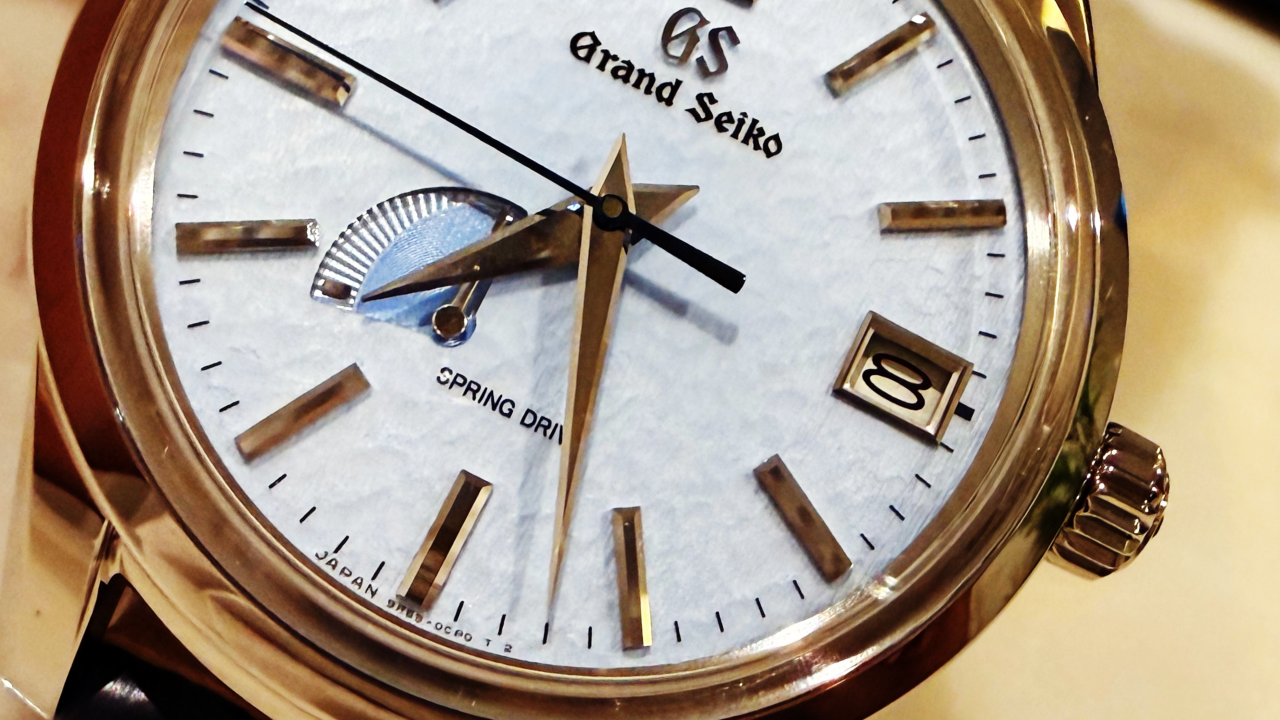
Take the brand’s treatment of surfaces. Zaratsu polishing is often mentioned as a finishing detail, but its importance is larger than that. It is not only a technique. It is part of the brand’s philosophy of visual exactness. On a strong Grand Seiko case, light does not merely bounce. It is disciplined. The polished plane, the sharp edge, the alternation between brilliance and restraint all educate the eye toward precision. The watch teaches the owner how to look at it.
That is not a small thing.
The same can be said of the hands and indexes. Grand Seiko does not merely make them sharp for effect. It makes them sharp so that light itself becomes legible, so that the act of reading the watch is elevated into an encounter with clarity. Many watches are attractive. Fewer give the impression that every visible element has been brought under a single demand for exactness.
This is one reason the loyalty becomes so intense. The object keeps rewarding attention.
And anything that deepens under attention will create a stronger bond than something that exhausts itself in the first impression.
The dial work offers another clue. Grand Seiko’s most admired dials, whether one thinks of the Snowflake, the White Birch, or several of the seasonally inflected references that have become central to the brand’s identity, are not compelling merely because they are textured. Texture by itself is easy. What matters is that the surface appears observed rather than invented. The dial often feels less like a decorative device than like the preservation of a condition of nature, light, or atmosphere.
That difference is profound.
The collector feels that the symbolism has not been pasted onto the object after the fact. He feels that the object and the symbolism belong to the same world. This is one of the deepest sources of trust a brand can create, especially in an age when so much luxury appears strategically assembled rather than culturally grounded.
This is also why the Japanese dimension must be treated with precision. It is easy to fall into vague language about mystery, quietness, or poetry. But those words, when left unattended, explain very little. The real matter is not mystery. It is integrity. Grand Seiko’s best watches feel as though they emerge from an aesthetic culture in which stillness, seasonality, surface, restraint, and exactness remain meaningfully related.
The brand does not feel Japanese because it performs an exotic identity. It feels Japanese because its strongest work appears to come from an intact aesthetic center.
Collectors can feel that. And when they feel that an object belongs to a real civilizational discipline rather than to a marketing exercise, loyalty becomes far more likely.
Technology matters in the same way. Spring Drive is not important merely because it is innovative. Innovation alone does not secure devotion. The luxury world is full of technical achievements that leave little permanent mark on the inner life of the collector. What gives Spring Drive its force is that it feels philosophically native to Grand Seiko. Its glide is not only smooth. It is composed. It proposes another emotional experience of time, one that feels less percussive and more continuous, less theatrical and more resolved.
One is not merely looking at a clever mechanism. One is looking at a brand that seems willing to articulate time differently without anxiety.
Collectors respect that kind of confidence.
They also recognize something else in Grand Seiko that should not be underestimated: it allows them to resist conformity without sacrificing standards. This may be one of the brand’s greatest strengths. A serious collector does not want difference at the price of rigor. He does not want to flatter himself with originality while quietly lowering the threshold of judgment. He wants an alternative that remains fully worthy of exacting respect.
Grand Seiko offers that possibility.
It allows a collector to stand outside the lazy repetition of prestige without falling into mere contrarianism. It allows him to admire the Swiss tradition without feeling imprisoned by it. It widens the field of legitimacy without lowering the bar.
That has enormous psychological power. The watch becomes more than an object of ownership. It becomes evidence of discernment. It becomes proof that one’s judgment is not dependent on familiarity alone. It becomes a way of saying that authority can be recognized even when it speaks in another accent.
That is why Grand Seiko enthusiasts often appear unusually committed. Their attachment is not simply the reflex of fandom. It is the consequence of recognition. They recognize in the brand a discipline that does not plead, a refinement that does not flatter, and a seriousness that does not need to become loud in order to be persuasive.
In the end, Grand Seiko does not command loyalty simply because it is not Swiss, nor simply because it is technologically compelling, nor simply because it carries Japanese cultural weight.
It commands loyalty because it offers one of the rarest things modern luxury can offer.
A complete alternative.
A different grammar of beauty. A different philosophy of precision. A different relationship between surface and seriousness. A different moral atmosphere around the object itself.
People may first turn toward Grand Seiko because it feels different.
They remain because the difference turns out to possess structure, discipline, and truth.
And once a collector discovers that kind of difference, leaving it behind is no longer a simple matter of preference.
It becomes a matter of conviction.
Mohammed Almarwani,
— Mohammed Almarwani, ACIArb, CEO, AllChrono