
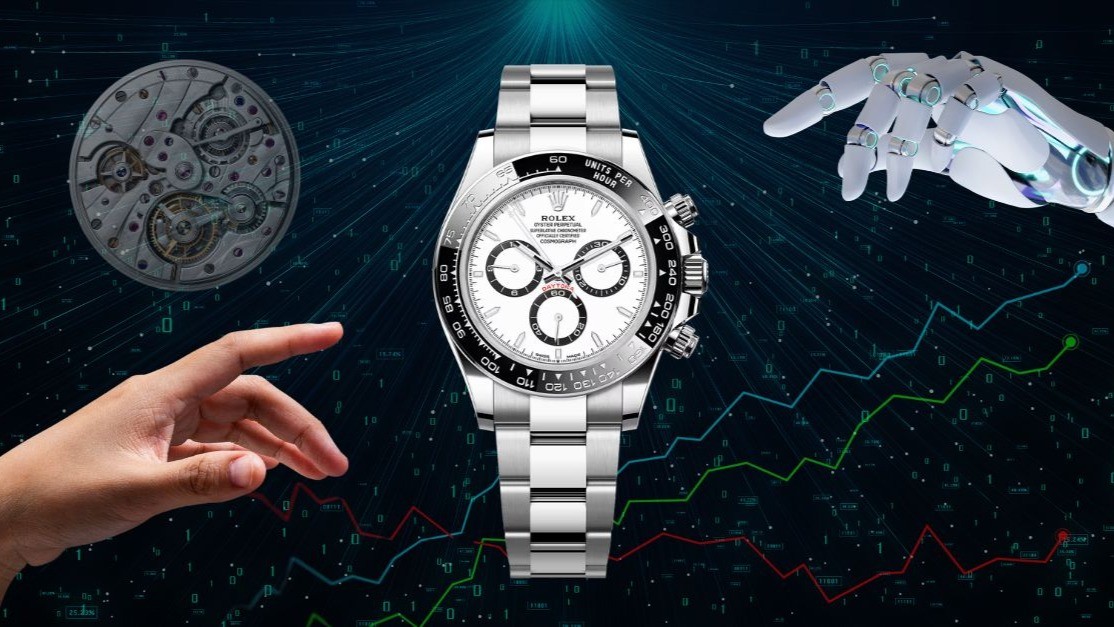
Across industries, AI is framed in apocalyptic terms: adapt or die.
In the secondary watch market, that framing misses the real shift.
I operate daily inside the global secondary watch market. What I see instead is something quieter: standardization and normalization. The structural foundations that allow the market to finally operate at scale and function the way it always should have. Without eroding the human craftsmanship that makes high horology special.
Here are four areas where AI changes everything.
1. Authentication: The Market's Biggest Unlock
The secondary market is ripe with demand, and even riper with distrust.
High rejection rates. Failed authentications. Deals collapsing at the final step. Every one of those erodes confidence and leaves capital idle.
AI-assisted visual authentication trained on large verified datasets can flag inconsistencies in dial printing, case geometry, and movement signatures faster and more consistently than manual review. Not to replace expert watchmakers, but to triage volume and elevate specialists to the genuinely complex calls.
When authentication becomes reliable and machine-verifiable, watches become financeable, insurable, lendable, and underwritable.
A Patek Philippe that meets institutional authentication standards does not simply become more desirable. It becomes eligible for structured capital.
Layer that with persistent digital provenance, not speculative NFTs but structured ownership records tied to service and transaction history, and the asset class changes structurally. Every transfer, every service, every cross-border movement documented.
That is incremental improvement towards infrastructure.
2. Pricing Transparency: The End of Information Asymmetry
There is no institutional-grade benchmark for watches.
What exists instead is fragmented listing data, partial transaction visibility, and relationship-driven knowledge accumulated over years. That information gap is where dealer margin has historically lived. Knowing more than the person across the table has long been the edge.
Platforms like WatchCharts have made meaningful progress in aggregating data, and that transparency matters. But aggregated data is not the same as standardized, audited, transaction-verified pricing infrastructure. The market still lacks a benchmark built on cleared institutional parameters.
AI closes that gap by aggregating verifiable data and normalizing it for condition, geography, and configuration.
The secondary market reached $26.8 billion in 2024 and is projected to approach $43.7 billion by 2031. Deloitte projects pre-owned will match the primary market within a decade. A market of that scale cannot operate indefinitely without benchmark infrastructure.
In the short term, greater transparency compresses margins. Over the long term, it broadens participation and deepens liquidity.
Markets mature when pricing becomes referenceable.
AI builds that reference.
And as pricing infrastructure matures, secondary values will increasingly inform primary pricing decisions. In certain segments, that inversion is already visible.
3. Fraud Detection: A Multi-Billion Structural Leak
Counterfeiting remains a multi-billion-dollar problem in the global watch industry, with tens of millions of fake watches estimated to circulate annually and significant economic distortion across online marketplaces and cross-border trade.
At that scale, the problem is beyond individual deception. It is structural weakness in verification and detection.
Dial typography, crown geometry, finishing tolerances, movement decoration signatures. These are pattern-based signals. AI systems trained on verified authentic and confirmed counterfeit references can identify inconsistencies with a scale and consistency no inspection team can match.
When counterfeit detection becomes embedded directly at the point of transaction, not only at customs but across platforms and private deals, the economics of mid-tier fakes begin to deteriorate. The probability of detection rises. The margin compresses. Risk shifts back to the counterfeiter.
A secondary effect follows. As authentication becomes data-driven and standardized, brands gain a pathway to participate directly in that verification layer by licensing authentication data into the secondary channel. That introduces structured exposure to a market they have historically resisted and materially reshapes the relationship between primary and pre-owned distribution.
4. Demand Forecasting: When Momentum Becomes Measurable
The people who win in the secondary market spot momentum before it's priced in. A reference moves quietly on a few platforms. Volume builds. Three months later it's everywhere and the opportunity is gone.
Experienced dealers have done this on instinct for years. AI does the same thing systematically, across search velocity, listing behavior, transaction acceleration, and social signal, and surfaces it before it becomes obvious.
Consumer interest in pre-owned has doubled since 2020, with 49% of buyers now motivated by value over buying new. As AI democratizes signal detection, short-term arbitrage compresses. The advantage shifts from speed to conviction.
Long-hold discipline beats hot-reference flipping. Capital allocated on evidence beats capital allocated on instinct.
That professionalizes the entire market.
What AI Cannot Touch
All of this operates at the market layer, the infrastructure of buying and selling.
None of it touches why watches matter.
As the world becomes more optimized, more frictionless, more digital, the value of analog craftsmanship rises. The finishing of a movement. The geometry of a bridge. The engineering tolerances inside a perpetual calendar. The decision a master watchmaker makes that no specification fully captures.
You cannot prompt your way to a Lange movement.
AI will make the watch market smarter, more trustworthy, and more accessible to serious capital. It will not make watchmaking less human.
If anything, it will make human craft more visible, because the infrastructure around it finally works.
The market becomes institutional. The art remains human.
The real question is what infrastructure layer will define the next decade of the watch market.
— Christian Bruhn