
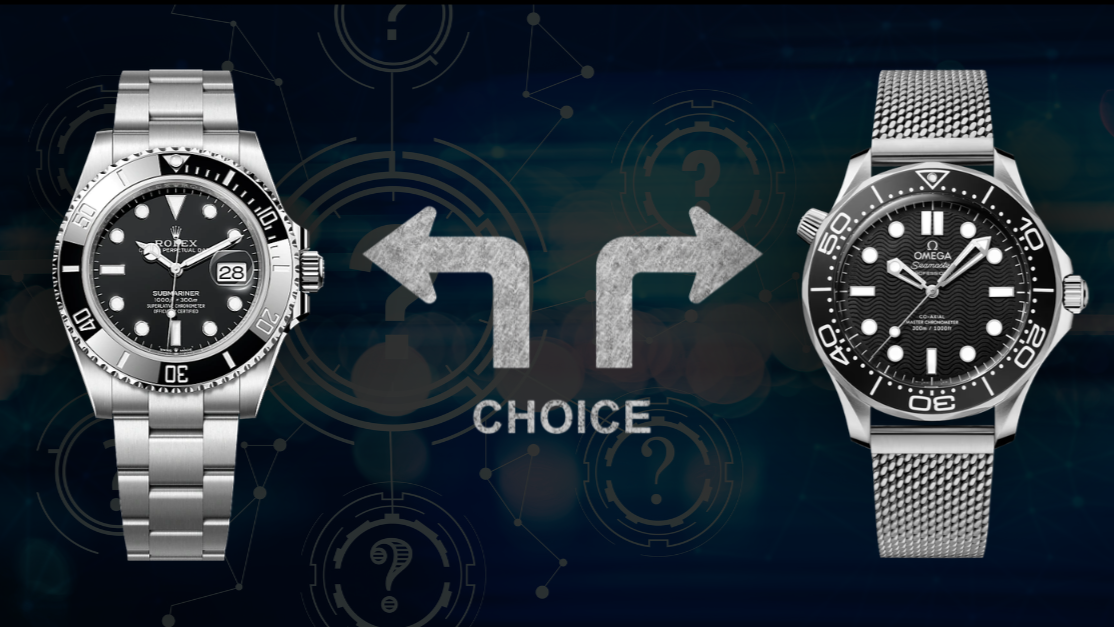
Most people start their watch search with the wrong question. They ask, “What’s the best watch?” instead of, “What’s the best watch for me?”
Choosing well is about matching a watch to your life, your wrist, and how you actually plan to use it.
Here’s a practical framework you can use whether you’re buying your first piece, upgrading, or adding to a collection.
1. Start with your “why”
Before you look at brands, movements, or complications, get clear on what the watch needs to do for you.
Ask yourself:
Is this mainly a daily watch, a dress piece, a sports/tool watch, or a fun “weekend” watch?
Do you want a single, versatile watch or one more very specific piece for a certain role?
Are you buying primarily for enjoyment, status, heirloom potential, or partly as an investment?
Will you be wearing this daily, a few times a month, or a few times a year?
Your answers immediately narrow your options:
A true daily watch needs comfort, versatility, and some toughness.
A dress watch can be slimmer, more refined, and less water‑resistant.
A dive watch or chronograph should prioritize legibility and robustness.
A “statement” watch can be bolder if you’re comfortable with attention.
If you skip this step, you risk buying something that photographs well but lives in a drawer.
2. Get the fit right: size, shape, and thickness
The single biggest reason people sell watches: they don’t love how they wear.
We talk a lot about case diameter, but fit is really a combination of:
Case diameter
Lug‑to‑lug length (how far the watch stretches across your wrist)
Case thickness
Case shape and curvature
As a loose guide (not a rulebook):
Smaller wrists (around 14–18 cm / ~5.5–7 in): often do best in the 36–40 mm range, with moderate thickness and shorter lug‑to‑lug.
Average wrists (~7–7.5 in): 38–42 mm works for most people, with 39–41 mm as a great everyday sweet spot.
Larger wrists: 42–46 mm can look balanced, but lug‑to‑lug and case shape matter more than the diameter alone.
Two crucial points:
Thickness matters as much as diameter. A 40 mm watch that’s very thick can feel more awkward than a 41 mm watch that’s slim and curved.
Lug‑to‑lug is your friend. A 39 mm watch with long, straight lugs can wear bigger than a 41 mm piece with compact, curved lugs.
If at all possible, try watches on in person, even if buying online. You’ll learn very quickly what feels natural on your wrist.
3. Style and occasion: where this watch will actually live
Next, match style to your real life, not your fantasy life.
Typical categories:
Dress watches Slim, simple, usually on leather. Think clean dials, minimal complications, and easy shirt‑cuff compatibility.
Everyday “one‑watch” pieces Versatile designs with neutral colors, 38–41 mm sizing, decent water resistance, and a bracelet or strap options. These need to look right with a t‑shirt and a blazer.
Sports/tool watches Divers, pilot’s watches, chronographs. They emphasize legibility, lume, rotating bezels, and robustness.
Statement or “fun” watches Bold colors, unusual shapes, or playful designs. Great as second or third watches once the core roles are covered.
In the current era, there’s a clear shift toward more timeless, wearable designs over loud, trend‑driven pieces. Smaller sizes, cleaner dials, and integrated or comfortable bracelets are winning because they work in more situations and age better visually.
Ask: “With my actual job, climate, and social life, where will this watch spend 80% of its time?” Start from there.
4. Movement and materials: what you’ll live with every day
Now that you know what role the watch will play and how it should fit, you can think about what’s inside and what it’s made of.
Movements
Mechanical / manual‑wind Romantic, traditional, and engaging. You interact with the watch by winding it. Great if you like ritual and connection to the mechanism.
Automatic Also mechanical, but self‑winding as you move. The modern default for luxury daily wear if you appreciate mechanics but don’t want to wind every day.
Quartz Battery‑powered, highly accurate, low maintenance. Often better for pure practicality. In some designs (especially slim dress watches), quartz can be a strength, not a weakness.
Question to ask yourself: “Do I want to interact with this watch as an object of mechanics, or do I mainly want it to tell time and look good with minimum fuss?”
Materials
Stainless steel is the standard: durable, versatile, and appropriate almost everywhere.
Titanium is lighter and often more comfortable, especially in larger sizes. It can scratch differently and feel more utilitarian.
Precious metals (gold, platinum, etc.) are heavier, more luxurious, and more noticeable. Great if you want a clear statement or heirloom piece.
Ceramic, carbon, and other modern materials are often lighter and scratch‑resistant, with a more contemporary look and feel.
Think about weight, how careful you are with your belongings, and whether you’re comfortable with visible wear over time.
5. If you’re buying on the secondary market
If you plan to buy pre‑owned, there’s one extra step that saves a lot of pain:
Go try the watch on first.
Even if you’re certain you want a particular model, always:
Visit a local authorized dealer or brand boutique.
Try the exact reference if you can. If not, try something with the same size, case shape, and thickness.
Pay attention to how it sits:
You don’t have to buy there. You can still go back to your preferred online dealer or platform afterwards. But you’re no longer guessing from photos and specs; you know what the watch actually feels like on your wrist.
This single step prevents a lot of “beautiful but unwearable” purchases.
6. Budget, value, and where you buy
Set your budget before you fall in love with a specific reference.
A few practical principles:
Decide what total amount you’re comfortable tying up in a watch. Include tax, possible service in the near future, and strap/bracelet changes.
Within your budget, look for the best combination of build quality, after‑sales service, and design you genuinely like. Do not just go for the most expensive logo you can stretch to.
New vs pre‑owned:
Buying new from an authorized retailer gives you full warranty and a known history, but often at a higher price.
Buying pre‑owned can give you more watch for the money, but you need to be more careful:
As a rule of thumb: don’t let “future value” be your primary justification. It’s fine as a tie‑breaker between two watches you equally love, but a risky reason to buy something you’re lukewarm on.
7. How to choose between your final 2–3 options
Most buyers struggle to pick between the last two or three watches.
Once you’ve narrowed it down, shift from research mode to decision mode.
Here’s a simple process:
1. Gut test
Put all finalists side by side in photos, on your wrist, or both.
Ask yourself: “If I had to walk out wearing just one of these today, which would I pick?”
Notice which watch you keep coming back to even after trying to talk yourself into the others.
Your first instinct is often more honest than an over‑analyzed pros/cons list.
2. Lifestyle test
For each final candidate, visualize a normal week: work, errands, dinners, weekends.
Which watch can you wear without thinking in most of those scenarios?
Which one feels slightly too formal, too sporty, or too loud for your actual routine?
If one watch is “perfect” but realistically only gets worn twice a month, and another works five days a week, that matters.
The watch that fits more of your real life usually ends up being the better choice.
3. Long‑term test
Ask one blunt question:
“If this watch never went up in value and no one on social media ever saw it, would I still be happy wearing it in five years?”
If your enthusiasm drops significantly when you remove resale value and external validation from the equation, be careful.
The right watch should make sense to you even if the market moves against it, because you’re the one who has to live with it.
4. Exit and risk test (especially for pre‑owned)
When you’re truly torn between two pieces you love:
Which one has better liquidity in the secondary market?
Which has clearer service history and more complete documentation (box, papers, receipts, recent service)?
Which would be easier to sell quickly at a fair price if your circumstances change?
That doesn’t mean you should only buy the most “liquid” watch. But when emotions are equal, choosing the one with cleaner downside and easier exit is simply prudent.
8. Bringing it all together
Choosing the right watch isn’t about finding the “best” watch on paper. It’s about alignment:
A clear purpose (why you’re buying it).
The right fit for your wrist and lifestyle.
A movement and material you’re happy to live with every day.
A decision process that respects both your emotions and your downside.
Use the boutique or AD to solve fit. Use your typical week to test reality. Use the five‑year question to test taste. Use liquidity and documentation as tie‑breakers.
Do that, and whatever you choose will feel less like a gamble, and more like a watch that was genuinely made for you.
— Christian Bruhn