
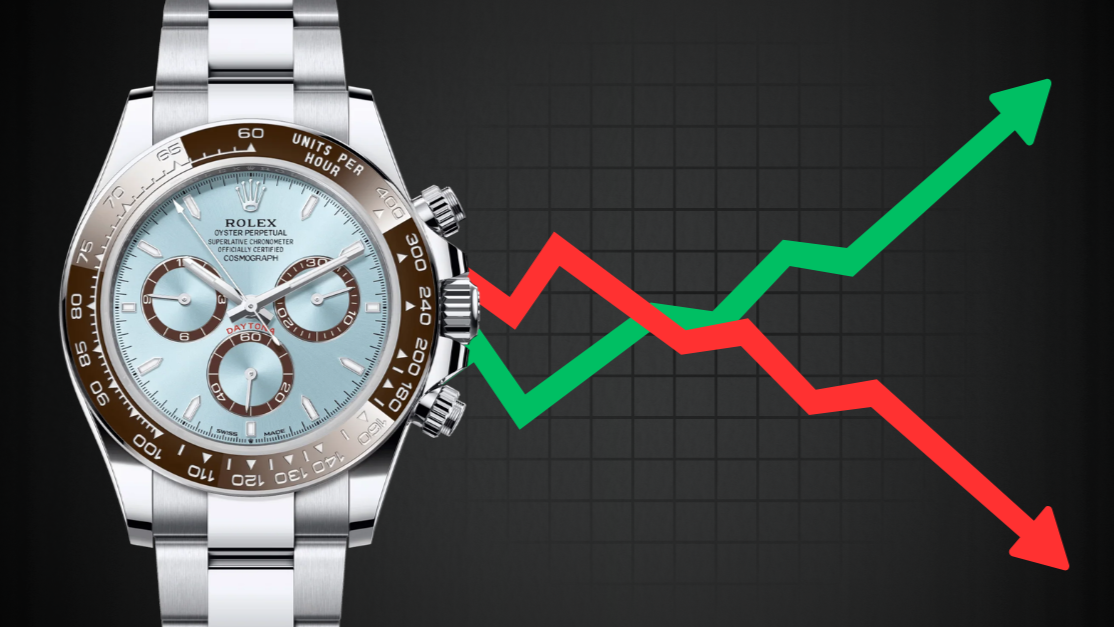
Last week I read three major watch market reports back to back. Bezel's 2025 Report. Chrono24's annual recap. EveryWatch's secondary market data, covered by WatchPro and SJX. Each one is useful on its own. Read together, they show where the market is actually headed.
Here are eight realities that stood out.
The secondary market is now half the industry.
The secondary watch market hit $16.7 billion in measurable sales last year. Up 36% year over year. When you include offline deals and private sales, the real number is probably closer to $25 billion. That is nearly half the entire primary retail market for new watches.
This is no longer a niche corner for flippers. It is a co-equal force shaping pricing, allocation, and brand strategy across the industry.
Rolex accounted for $5.7 billion of that. Nearly a third of all secondary volume.
Now here's where it gets uncomfortable.
Over one third of watches submitted for sale failed authentication.
Bezel rejected 34% of all watches submitted for sale in 2025. That isn’t noise. That is a systemic issue. And Rolex, the King of watches, made up 51% of those rejections.
One brand. A third of secondary value. Over half of all authentication failures.
Fraud is getting smarter.
The reasons are straightforward. When a brand is the most wanted thing in the room, the incentive to fake it is highest.
The closed casebacks Rolex is known for make it easier. A counterfeit movement behind a solid back can survive a casual look. An exhibition caseback forces honesty by design.
But what surprised me most was where the fraud is shifting. Bezel's case studies show that fakes are increasingly not about the watch itself.
They are about the set and contents.
Counterfeit guarantee cards with impossible reference numbers. Authentic warranty documents paired with the wrong watch. Fraudulent caseback engravings created to tie mismatched serials together.
Most buyers think authenticity means "is the watch real." The full question is whether the entire set is real.
Now look at what Rolex actually did this year.
Rolex is engineering around the risk.
The Land-Dweller launched with their first sapphire caseback on a steel watch. I do not believe that is a coincidence. It is a countermeasure.
They also expanded the 1908 and added display backs to select Daytonas. The direction is deliberate. I expect more open casebacks across the lineup in the next few years.
Rolex Certified Pre-Owned hit $590 million in sales. Up 204% year over year.
They are not observing the secondary market. They are building infrastructure to control it. The push toward proprietary boutiques follows the same logic.
When your brand represents a third of a $17 billion market and over half of authentication failures, vertical control is not optional.
A few other things that jumped out.
White gold is mispriced.
White gold is 2% of secondary market activity.
That number shocked me.
It looks almost identical to steel on the wrist, carries the weight and finishing of a precious metal, and depreciates as if none of that matters.
With gold prices climbing all year and replacement costs resetting upward, white gold from Lange, Vacheron, and AP is one of the better value plays available right now. Real material value at a fraction of what yellow or rose gold commands. The market has not caught up to this yet.
The elegance shift is real.
Evolving style is showing up everywhere in the data:
Rectangular cases up 9.3%.
Moon phase demand up 15.3%.
Champagne dials up 7.9%.
Green dials up 9.5%.
The market is rotating away from sport-watch dominance.
Cartier grew 8.3% on the strength of Tank and Santos demand.
Vacheron Constantin outperformed Patek and AP with 13.4% growth.
IWC staged a 14.4% comeback.
Tudor keeps closing the gap with Omega.
Collectors are shifting toward elegance and craftsmanship. Less noise. Less reflex buying. More long-term intent.
The women’s secondary market barely exists.
Women represent 35% of primary luxury watch sales according to Deloitte. On the secondary market, they barely register.
Sub-36mm watches are a rounding error on most platforms. That disconnect is the single biggest untapped opportunity in pre-owned watches.
The first platform to build a credible secondary experience for women will own a category that barely exists today.
The US market is moving independently and leading.
US transaction prices climbed 8.43% year over year despite tariffs, political uncertainty, and volatile equities.
Almost zero correlation to any of it. Collectors kept buying at higher prices.
From the operator side, we have felt this shift in real time over the past twelve months. Fewer window shoppers kicking tires. More deliberate conversations. People asking better questions about movement quality, service history, and long-term value.
The tourist investors left. Flippers got crushed by hype.
What remains is a market that rewards people who actually care about watches.
Sophisticated buyers are looking past Rolex, Patek, and AP and asking what comes next.
Independent Brands. A. Lange & Söhne. Vacheron Constantin. Grand Seiko. Glashütte Original.
Brands where finishing and movement quality outperform the name on the dial, often at prices that reflect how underappreciated they still are.
In 2021 the market rewarded speed.
In 2025 it rewarded discernment.
In 2026 and beyond, it will reward infrastructure and trust.
Sources: Bezel 2025 Report, Chrono24 2025 Market Review, EveryWatch/WatchPro Secondary Market Data, SJX Watches, Phillips Auction Results, Deloitte Swiss Watch Industry Study 2025
— Christian Bruhn