
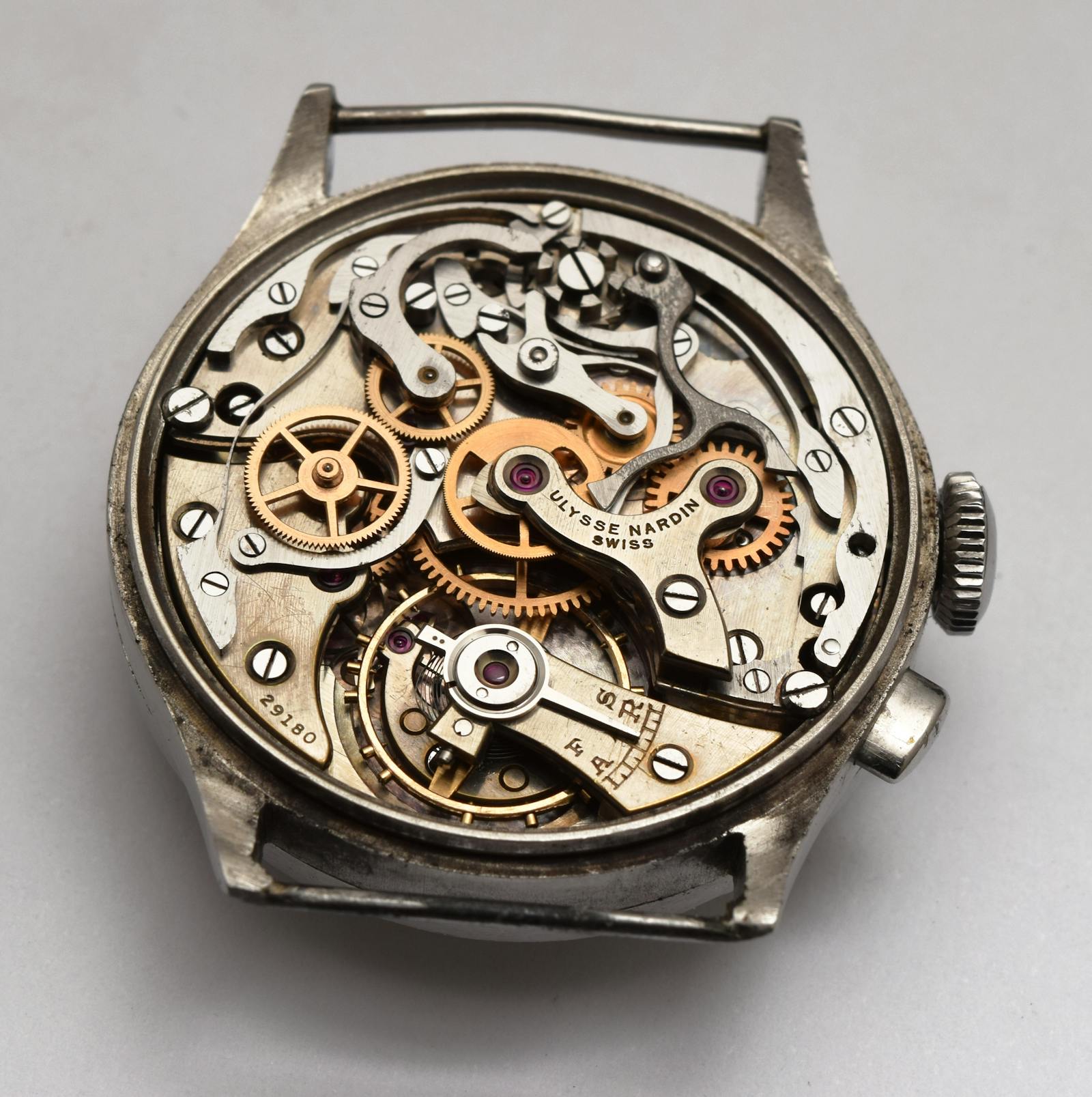
The first time you put a 1960s chronograph under a 10x loupe, the experience is disorienting. What looked like a clean dial across a dealer's display case is suddenly a landscape — printing inconsistencies, oxidation patterns, lume craters, the faint shadows where a tritium marker has lifted and been pushed back into place. None of it is on the spec sheet. All of it determines what the piece is worth.
This is a working guide to reading that landscape. It is written for the buyer who has decided they want a vintage chronograph and now needs to know what they are actually looking at — what counts as character, what counts as a problem, and what counts as a piece that has been quietly rebuilt under the dial.
Authentication of a vintage chronograph is half optics and half archeology. The reference number tells you which production years to expect; everything else has to match that period.
Why the dial carries the value
In a vintage chronograph, the dial is the single most heavily weighted component of the price. The case can be polished and re-finished. The movement can be serviced. The bezel insert can be replaced. The bracelet can be re-linked or swapped. But the dial — the original printed surface that left the factory with that specific watch — is irreplaceable in the literal sense: when it is gone, the value premium associated with originality is gone too.
The market quietly accepts this. A 1969 Daytona reference 6263 with an original "Mark 1" Sigma dial in honest condition will trade at multiples of the same reference with a service-replacement dial, even when the service dial is the visually cleaner of the two. The same piece is worth meaningfully different money depending on a 30-millimetre disc that most owners will never look at past arm's length.
So the question, every time, is some version of the same question: is this dial original to this watch, and is it in the condition it claims to be?
The four prints that anchor a period
There are four kinds of printed information on a vintage chronograph dial, and they age in slightly different ways. Reading each one in isolation tells you whether the dial is consistent with the production year stamped on the case.
1. The brand wordmark. This is what most people look at first, and it is the least diagnostic. Brand logos were the most carefully controlled part of a dial, and counterfeiters have been getting them right for decades. Use the wordmark to confirm the brand, not to date the watch.
2. The model line and reference markings. Below the wordmark, a vintage chronograph usually carries a model name (Daytona, Speedmaster, Carrera, El Primero) and sometimes additional descriptors ("Cosmograph", "Professional", "Automatic"). The exact wording, font weight, and spacing of these markings shift between production years in ways that are well documented for the major references. A Daytona dial that says "Cosmograph" above "Daytona" sits in a different production window than one that says "Daytona" alone or "Daytona" above "Cosmograph". This is the layer where mistakes are common — both honest service replacements and forgeries — because the variations are subtle enough that a cursory glance accepts the dial.
3. The chapter ring and sub-dial printing. The minutes ring, the tachymeter scale (if applied to the dial rather than the bezel), and the hour and minute graduations on the sub-dials are the densest source of period information. Stroke weight, the exact angle of the printed indices, the proportion of the sub-dial printing relative to the central dial — these are decisions the factory revisited regularly, sometimes year over year, and they leave a fingerprint. A dial with a stroke weight that is slightly too heavy for its stated reference year is a flag, even when nothing else is obviously wrong.
4. The depth-rating line. Below the centre of most vintage chronograph dials, you will find a small print declaring water resistance — "30m", "50m", "100m", "Water Resist", or in some early references nothing at all. The exact wording on this line shifts in narrow windows. A 1969 dial that quotes "100m" instead of the period-correct "50m" is unlikely to be an honest dial.
When all four prints align with the case, the case-back, and the movement caliber, the dial is internally consistent with the period. When one of the four is off by a year or a generation, something has been replaced.
Tropical, oxidised, faded — and what each one means
The other half of dial reading is the chemistry. Vintage dials age, and they age unevenly. The terminology around how they age has hardened into a market vocabulary that is worth knowing precisely, because each term implies a specific condition and a specific price effect.
Tropical. A dial that has shifted, usually under sustained UV exposure, from its original black or charcoal to a warm brown. The shift is irreversible, organic to the lacquer chemistry of the period, and — when even — actively desirable. Collectors pay premiums for matched tropical dials, particularly when the patina is consistent across the chapter ring and sub-dials. Uneven tropicalisation, where one sub-dial has shifted heavily and the others have not, is a flag: the most common cause is dial replacement at service, with one component carrying its original lacquer and another carrying a later replacement that did not age the same way.
Spider. A web of fine cracks that develops in the dial lacquer over decades, particularly in dials made from cellulose-based paint. Spidering is character, not damage, when it is fine and even. It becomes damage when it lifts, flakes, or reveals the metal substrate.
Faded. Pigment loss, typically on coloured dials (the white "Panda" sub-dials of a black-and-white Daytona, the silver chapter rings of mid-1960s pieces). Light fading reads as soft and intentional. Heavy fading reads as wear and reduces value.
Oxidised. Rust spots, usually visible as small dark dots near the perimeter of the dial. Almost always a sign that moisture has reached the dial — which means it has reached the movement. Oxidation is the only one of these patterns that is unambiguously a problem.
The lume question
Hour markers and hand luminescence is the second-most diagnostic feature of a vintage dial after the printing. From the early 1960s through 1998, the major Swiss makers used tritium-based lume, which decays predictably over decades. By 2026, all original tritium lume on a dial that left the factory before 1995 should read as creamy, sometimes greenish, sometimes warm yellow — never bright white, never neon green.
The hand-and-marker match is critical. Original tritium hands and markers age in lockstep, because they were charged from the same batch and have aged in the same case. If the hour markers read warm cream and the hands read bright white, the hands have been replaced. If three of the eleven hour markers are slightly brighter than the rest, three markers have been replaced.
The market accepts replaced hands more readily than replaced markers. Hands wear out, take damage, get repainted at service. The premium falls but the watch is still a "watch with original dial". Replaced markers, on the other hand, mean the dial has been opened up — and any time a vintage dial has been opened up, the surrounding printing has almost certainly been touched.
When a service dial is acceptable
Not every vintage chronograph carries an original dial. The market is large enough that some of them do not need to. There are at least three scenarios in which a period-correct service dial — installed by an authorised service centre, drawn from period factory stock — is acceptable to most collectors:
- The original dial was destroyed by a documented incident (water ingress, heat damage) and the replacement happened during the watch's normal service life, not as a value-engineering exercise at sale.
- The piece is being acquired as a wearer rather than a collector grade investment, and the price reflects the service dial honestly.
- The reference is rare enough that the alternative is no dial at all, and the buyer is comfortable with the trade.
What is not acceptable, ever, is an undisclosed service dial sold at a price that implies original. The difference between the two outcomes — disclosed or undisclosed — is the entire foundation of trust in the vintage market.
What we look for, and what we ship with the piece
When a vintage chronograph passes through AllChrono's authentication desk, the dial-reading process runs against a reference library of period-correct prints, lume curves, and case-paired dial pairings for every major reference. The result is a digital provenance dossier — anchored on chain — that travels with the watch for the rest of its life.
For a buyer, that dossier means the dial reading has already been done by a horologist whose entire job is doing it. For a seller, it means the work of proving originality is no longer a recurring cost every time the watch trades hands.
The dial is the watch. Reading it is the trade. We are committed to making both of those statements provable.
— Rina Yamamoto, Tokyo Bureau