
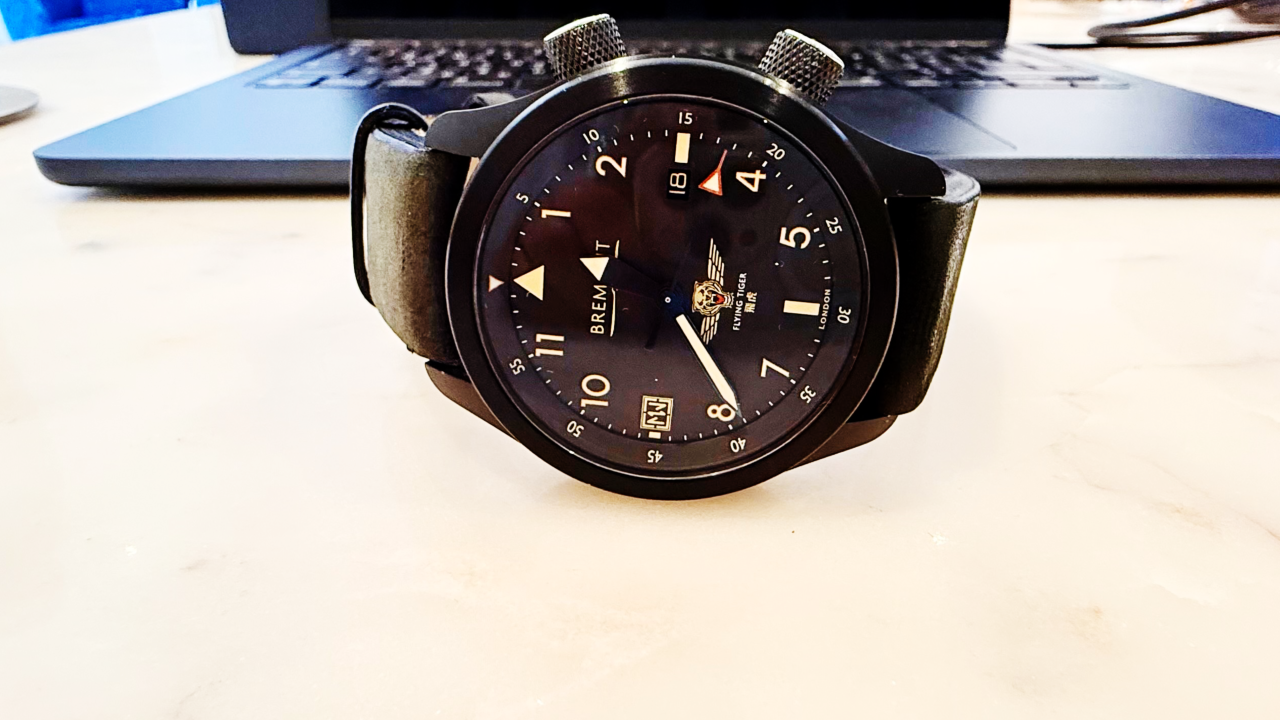
A reflection on my Bremont MWII Flying Tiger, the American-Chinese wartime memory it honors, and a brand that once knew exactly what it was.
Some watches tell time.
A few keep faith.
My Bremont MWII Flying Tiger, number 055 of 500, belongs to the second category.
I do not say that because it is limited, or because it carries military cues, or because it comes from an earlier and increasingly cherished chapter of Bremont. I say it because this watch carries history in a way that still feels morally alive. It does not merely borrow a symbol. It remembers an alliance.
To understand this piece properly, one must begin not with the case, nor the lume, nor even the dial.
One must begin with the blood chit.
That small piece of cloth, carried by Flying Tigers personnel, asked Chinese soldiers and civilians to rescue and protect the bearer because he had come to China to help in the war effort. There is something profoundly moving in that. Behind the legend, behind the shark mouth, behind the romance of wartime aviation, there was dependence. A fallen pilot could be brave, trained, and armed, but once he was on the ground, his fate might rest in the hands of ordinary Chinese civilians willing to risk themselves for a foreign man who had come to fight for their sky.
That is not branding.
That is human history.
And that is why the Flying Tigers should never be reduced to mere nose art and mythology. Yes, they were Americans. Yes, they became part of American wartime legend. But they were also volunteers in a Chinese war, flying in defense of China at one of the darkest moments of the twentieth century. Their story belongs not only to American courage, but to Chinese endurance, Chinese sacrifice, and that rare wartime moment in which two nations, from vastly different worlds, found a common cause under fire.
That is what gives this watch its soul.
But the intelligence of this watch is not only historical.
It is architectural.
This is where old Bremont was often at its best. The barrel-centered case construction gives the watch its stance, but also its seriousness. It does not feel like a flat object dressed in military styling. It feels built around containment, protection, and durability. The mass sits where it should. The middle case gives the watch tension and grip, but more importantly, structure. There is an anti-shock logic to the whole composition that suits the subject perfectly. A watch honoring aviators in wartime should not feel delicate, ornamental, or theatrically vintage. It should feel protected. It should feel engineered to endure disturbance.
This one does.
That is part of why the design succeeds. The history is on the dial, but the intelligence is in the case.
And then there is the insignia itself at the center.
I say this plainly and without hesitation: I believe it is one of the most beautifully executed insignia ever placed on a watch dial.
Not because it is loud.
Because it is exact.
Because it carries force without becoming cartoonish. Because it sits on the dial with conviction. Because it transforms the watch from an object of design into an object of remembrance. The tiger is fierce without excess. The wings give it lift. The Chinese characters below it anchor the emblem in the history from which it came. It is not there as decoration. It is there as witness.
Very few dials achieve that.
Most themed watches explain themselves too much. They become costumes. They become illustrations. They become sentimental. This one does not. This one knows when to stop. That restraint is part of why it works. It gives the insignia room to speak, and the insignia speaks with rare authority.
The darkened case does not feel decorative. It feels disciplined. The vintage-toned lume brings warmth without collapsing into nostalgia. The blued hands animate the dial without disturbing its seriousness. Even the overall posture of the watch feels correct. It does not seek charm. It seeks presence.
That quality was not accidental.
It came from a Bremont that still knew how to be Bremont.
This is the point that matters to me most.
The older Bremont, whatever its flaws, had an identity that was specific, authored, and unmistakable. It believed in aviation not as a marketing flavor, but as part of its inner language. It believed in Britishness not as a flag pinned lazily to a narrative, but as a design temperament. It believed in seriousness, in texture, in mechanical weight, in watches that felt as though they had been made by people with convictions rather than by committees searching for broad approval.
That Bremont was not perfect. It could be overly earnest. It could lean heavily into the story. It could at times be too insistent in its symbolism.
But it had a face.
And in watchmaking, having a face is no small thing.
The MWII Flying Tiger could only have come from that Bremont. It is too specific to have emerged from a softened and generic brand language. A British watch honoring an American volunteer unit that fought for China is not an easy commercial story. It is layered. It is historically charged. It requires seriousness. It requires a company willing to believe that memory is stronger than trend.
Old Bremont believed that.
That is why this watch now means more to me than it would have when it was first released. Today, it does not only represent the Flying Tigers. It also represents a vanished version of the brand itself.
A Bremont before the dilution.
A Bremont before the flattening.
A Bremont before the confidence began to slip.
My criticism of the current direction is not rooted in nostalgia for nostalgia’s sake. Brands can evolve. They should evolve. Capital is not inherently destructive. Leadership changes are not automatically betrayals. But there is a difference between evolution and erasure.
A serious rebrand should distill a house into its clearest form. It should sharpen identity, not dissolve it. It should remove noise while preserving character. What happened to Bremont, in my view, was something else. The brand began to step away from the very codes that once made it legible at a glance. In doing so, it moved closer to the generic center of luxury branding, where everything is smoother, broader, more portable, and less memorable.
That is always a dangerous trade.
Because once a watch brand begins to resemble a category instead of a culture, it may remain commercially functional, but it becomes harder to love. The collector feels that early. He feels it before the market has language for it. He feels it when the symbols no longer carry the same confidence. He feels it when the grammar changes. He feels it when a brand stops saying, this is who we are, and begins saying, this should appeal to more people.
That is the loss.
And that is why this Flying Tiger feels so important to me now.
It reminds me of a Bremont that still had the courage to be specific.
A Bremont that still knew how to carry history without turning it into costume.
A Bremont that still understood that a watch can hold more than design, more than function, and more than brand equity.
A Bremont that still knew that identity is not a surface treatment. It is infrastructure.
When I look at this watch, I do not simply see a limited edition from 2019.
I see the blood chit.
I see the fragile trust between a downed foreign pilot and a Chinese civilian.
I see the strange and serious dignity of an American unit fighting in Chinese skies.
I see one of the most beautifully executed insignia ever placed on a dial.
And I see Bremont before it became uncertain of its own face.
This is Bremont before becoming not Bremont.
And that is exactly why I will keep it.
Mohammed Almarwani,
— Mohammed Almarwani, ACIArb, CEO, AllChrono