
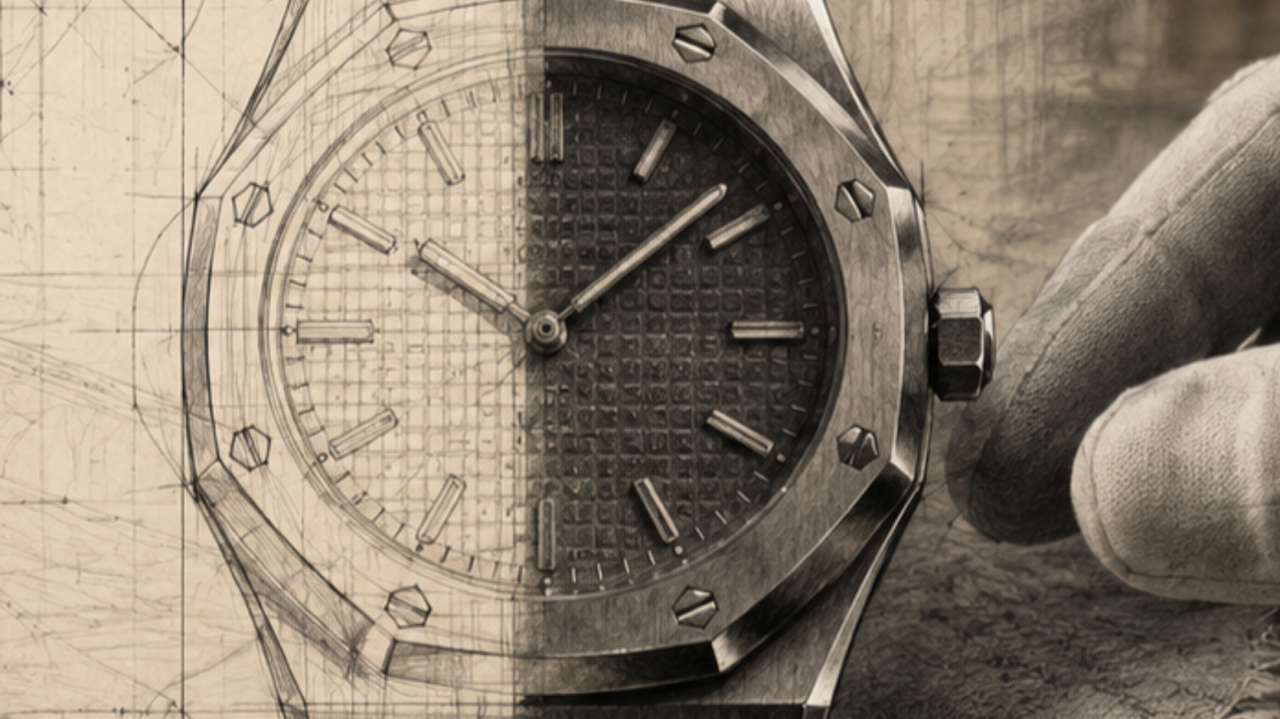
Some watches eventually stop being ordinary products and become part of cultural memory. At that point, the manufacture may still own the reference, the trademark, and the legal right to reinterpret it, but it no longer fully owns the meaning. That is where the question changes from ownership to custodianship, and where the real test of modern luxury begins.
A manufacture can own a reference.
It can own the name, the trademark, the archive, the boutique window, the campaign, and the legal right to produce, resize, reinterpret, collaborate, or market an object.
But it does not fully own the meaning.
That is the line the watch industry has to understand.
Because some watches eventually leave the category of product. They enter cultural memory. They become evidence of a moment when design found a new language and had the courage to place it on the wrist.
At that point, ownership is no longer the only question.
Custodianship becomes the question.
This is why the current debate around icons feels larger than one launch, one collaboration, or one brand decision. The issue is not whether a playful object can sell. It can. The issue is not whether a famous design can travel into a wider market. It can.
The real issue is whether the industry still understands the difference between extending heritage and spending it.
Politics gives us a useful language here.
Not politics as ideology.
Politics as structure.
A serious political system is never built on one instinct alone. It lives between access and order, reform and continuity, public mandate and institutional restraint. A nation that only protects becomes rigid. A nation that only opens becomes unstable.
A great watch house faces the same tension.
It must invite without cheapening.
It must preserve without embalming.
It must renew without vandalizing the language that gave it authority.
Access and Preservation
If the Democrats were watchmakers, their first instinct would be access. They would argue that icons should not remain locked behind inherited wealth, boutique rituals, waiting lists, and the quiet intimidation that sometimes surrounds high luxury. They would want younger collectors to enter the room. They would want the dream to feel less sealed.
There is dignity in that instinct.
Watchmaking cannot survive as a private dialect spoken only by those who already know the rules. A culture that refuses new blood eventually mistakes exclusion for seriousness.
But access has its own corruption.
When access becomes the highest virtue, the object can be simplified until it loses the discipline that made it worth approaching. The door opens, but the room loses its architecture. The symbol reaches more people, but arrives thinner, louder, easier, less dangerous.
If the Republicans were watchmakers, their first instinct would be preservation. They would speak of inheritance, hierarchy, continuity, ownership, and the duty to protect what previous generations built.
There is dignity in that too.
Not every hierarchy is corruption. Some hierarchies are memory arranged in visible form. Some objects need distance because distance is part of how authority survives. A great design cannot be treated like a campaign slogan without paying a price.
But preservation also has its own corruption.
It can become entitlement. It can turn guardianship into possession. A manufacture can speak of heritage while behaving like a landlord collecting rent from a building it did not design.
Then there is the sovereignty instinct.
Translated into watchmaking, it would defend the manufacture against the flattening machinery of global taste. Its language would be the workshop, the national school, the local grammar, the right of a house to speak in its own voice without asking fashion for permission.
That instinct can produce powerful watchmaking.
A watch with spine.
A watch that does not apologize for its architecture.
But sovereignty can also become a fortress. A house that only protects itself eventually stops hearing the world around it.
Then there is the regionalist instinct.
It begins from another place. Not the capital, but the region. Not the dominant house, but the smaller language. Not the industrial center, but the craft tradition at the edge.
That instinct is close to the soul of independent watchmaking.
It protects what empires usually flatten.
But even the small story can become too precious. Craft can become self-conscious. An object can explain itself so carefully that it loses force.
This is why great watchmaking is harder than politics.
Politics can survive on slogans.
A watch cannot.
A watch has to carry its philosophy in proportion, metal, silence, weight, and touch. The case either has authority or it does not. The bracelet either belongs to the body or it does not. The design either holds its nerve or becomes decoration wearing a famous name.
The Cultural Whip
There is another political word the watch industry should take seriously.
The whip.
Not the theatrical version of politics. The institutional one.
The whip is the keeper of discipline. He senses where loyalty is weakening. He knows when the group is drifting from what it claims to believe. Before the public vote, before the public statement, before the damage becomes visible, he understands whether the internal order is still intact.
A serious manufacture needs its own version of that.
Not a political whip.
A cultural one.
Someone inside the house must be able to say: this will sell, but it will weaken us.
This will create attention, but it will lower the meaning.
This will bring the icon closer to the public, but it will also teach the public to see the icon as a graphic asset rather than a design achievement.
That voice matters.
Without it, the marketing department becomes the party leader. The collaboration becomes the campaign. The icon becomes the slogan.
And slogans travel quickly.
They also age badly.
The strongest maisons were not built by creativity alone. They were built by restraint. Someone knew what should not be done. Someone protected proportion. Someone protected silence. Someone understood that novelty is not automatically progress, and visibility is not automatically vitality.
That is the missing institution in parts of modern luxury.
Not creativity.
Not attention.
Discipline.
A maison with no internal discipline eventually mistakes motion for progress. It lets every commercial opportunity present itself as cultural expansion. It allows short-term visibility to dress itself as strategy.
But heritage cannot be governed by campaign logic.
An icon needs a constitution. And sometimes it needs someone powerful enough to say no.
The Bipartisan Constitution
This is where bipartisanship becomes useful.
Not the decorative kind. Not the ceremonial handshake. Not the empty statement that survives because it says nothing.
Real bipartisanship begins when opposing instincts recognize that something larger than their own appetite is at stake.
In watchmaking, the mature position is not access against protection. It is the point where both sides grow up.
The democratic instinct must admit that not everything becomes better when it becomes more available.
The conservative instinct must admit that heritage cannot survive by becoming untouchable.
One side wants the door opened.
The other wants the room protected.
Great watchmaking needs both.
An icon that is never renewed becomes embalmed. An icon that is endlessly democratized becomes exhausted. The question is not whether the public should be allowed near the object. The question is whether the object can meet the public without losing the discipline that made it worth approaching.
That is the bipartisan constitution of heritage.
Access matters, but vulgarity is not access.
Protection matters, but paralysis is not guardianship.
Renewal matters, but vandalism is not courage.
Memory matters, but memory should not be mined until nothing is left.
Heritage as Capital
This is not only cultural.
It is economic.
Luxury houses often speak of heritage as if it were decoration. It is not. Heritage is capital. It is accumulated trust, design authority, collector memory, pricing power, scarcity, restraint, and cultural consent. It may not sit neatly on a balance sheet, but it is one of the most valuable assets a manufacture owns.
Like all capital, it can be invested.
It can be preserved.
It can also be consumed.
The temptation in modern luxury is to convert inherited meaning into short-term liquidity. A famous silhouette becomes a campaign machine. A great design becomes a bridge into a lower price point. A historic reference becomes a color exercise. The queue forms. The headlines arrive. The younger audience enters. Everyone calls it success.
But a brand can sell the future without noticing.
Pricing power weakens first in the imagination before it weakens in the market.
The damage rarely appears in the first season. Icons do not usually collapse. They erode through repeated permission.
Each casual use teaches the public a new lesson.
The house may believe it is extending the myth.
The culture may begin to understand that the myth can be rented.
That is a dangerous economic lesson.
The strongest luxury brands do not live from scarcity alone. They live from coherence. They live from the belief that the house knows what it must refuse, even when refusal costs money.
Restraint is not anti-commercial.
Restraint protects future margin.
It protects authority.
It protects the seriousness of the next yes.
Toward a Watchmaking World Heritage
This is why the watch industry needs something like UNESCO World Heritage for its great designs.
Not because watchmaking should become a museum.
Not because creativity needs permission.
But because some designs eventually cross a line. They stop being ordinary products and become part of cultural memory.
UNESCO does not protect a historic site because stone cannot be moved. It protects it because the site has become evidence of a civilization, a discipline, a language, a moment when human imagination reached a form that could not easily be repeated.
Certain watches have reached that level.
The Royal Oak is not only a successful reference. It is an architectural event in steel.
The Nautilus is not only a luxury sports watch. It is another argument from the same extraordinary mind.
The Tank, the Reverso, the Speedmaster, the Royal Oak, the Nautilus. They are not equal in function, story, or cultural weight. But each has crossed from catalogue into memory.
A manufacture may own the name.
It may own the reference.
It may own the legal right to reinterpret it.
But it does not fully own the meaning.
The meaning belongs also to the history of design. To collectors. To watchmakers. To the culture that gave the object its authority. And sometimes to the designer who is no longer alive to defend the work.
That is where responsibility becomes heavier.
There is a difference between evolving an icon and exhausting it.
There is a difference between renewal and extraction.
There is a difference between making heritage visible to a new generation and using heritage because the future has become harder to build.
This is not an argument against collaboration.
It is not an argument against accessibility.
It is not even an argument against playfulness.
Watchmaking has always needed courage.
But courage is not the same as lowering the temperature of an icon until it becomes a graphic, a color exercise, or a shortcut.
Some watches can carry humor, provocation, even irreverence.
A few designs require restraint because they are no longer merely assets inside a brand portfolio. They are part of the patrimony of watchmaking itself.
And when a house has lived for decades under the shelter of one great design, its obligation is not only to monetize that shelter.
It must prove that it can still build beyond it.
That is the true test of a manufacture.
The test is not how loudly it can recycle memory.
It is whether it can create the next object worthy of being remembered.
The Royal Oak was never merely a shape. It was a rupture. Steel made aristocratic. Industrial language elevated into high watchmaking. A dangerous object because it made the luxury watch look less like inherited jewelry and more like designed power.
That is why its legacy is fragile.
Not because demand has disappeared.
Not because young collectors do not understand it.
Not because the market has changed.
It is fragile because the brand must keep proving that the icon was not an accident it has spent half a century monetizing.
Every great house eventually faces this test.
Can it protect meaning without freezing it?
Can it invite new generations without flattening the object?
Can it honor the past without hiding behind it?
The tragedy of modern luxury is that many houses now understand attention better than meaning. Attention can be bought with color, noise, scarcity, collaborations, queues, and controlled leaks.
Meaning cannot.
Meaning is slower.
Meaning is what remains after the campaign is over.
A watch can survive being playful. It can survive being colorful. It can survive being accessible. It can even survive being misunderstood for a season.
What it cannot survive forever is being used against itself.
Once an icon becomes only a logo that can be reissued in any material, at any price, under any emotional justification, the market may still applaud, but the object has already entered a different category.
It is no longer being guarded. It is being harvested.
Gérald Genta gave the industry more than shapes.
He gave it a grammar.
If the industry keeps spending that grammar without protecting it, one day it will discover that the language itself has weakened.
And when heritage is treated too casually, the damage is not only to one watch, one brand, or one collaboration.
The damage is to the memory of watchmaking itself.
That is why the real question is not whether a royal object can become pop.
The real question is whether, after becoming pop, it can still remain royal.
And if the answer is no, the industry has not democratized an icon.
It has spent one.
— Mohammed Almarwani, ACIArb, CEO, AllChrono