
Blancpain, the Complete Calendar, and the Value of Restraint
A reflection on Blancpain’s complete calendar, ceremonial restraint, and why continuity remains the most misunderstood virtue in modern watchmaking.
In contemporary watchmaking, innovation often arrives loudly.
Materials are announced. Complications are escalated. Visibility becomes strategy.
Continuity, by contrast, is rarely celebrated.
The Blancpain Villeret Quantième Complet Demi Savonnette does not attempt to participate in that volume. It operates within a different philosophy, one rooted not in reinvention, but in preservation executed with discipline.
The complete calendar is among the most balanced constructions in mechanical horology. Unlike a perpetual calendar, it does not pursue mechanical absolutism. It does not eliminate irregularity. February still requires intervention. The owner remains part of the mechanism’s rhythm.
That is not a limitation.
It is a position.
A complete calendar assumes that time is structured, yet not obedient. It assumes awareness. It assumes participation. In an era defined by automation and digital certainty, this form of mechanical engagement feels increasingly intentional.
Blancpain has long treated this configuration not as an intermediate complication, but as an architectural language. During periods when mechanical watchmaking was simplified or exaggerated, the complete calendar with moonphase remained one of the maison’s most disciplined expressions.
The Villeret case provides the framework for that continuity.
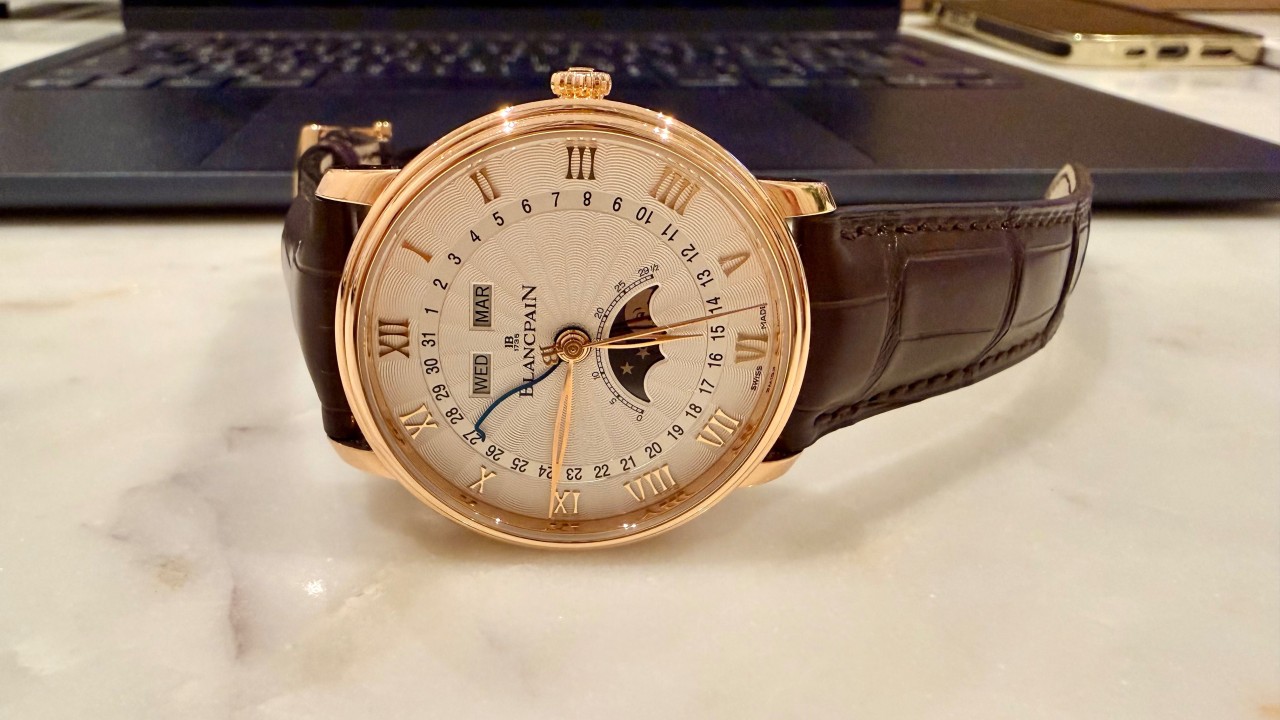
The stepped bezel introduces light without aggression. The lugs curve inward with restraint. The flanks remain uninterrupted. Even the calendar correctors are discreetly integrated, preserving proportion rather than advertising mechanism. Engineering serves line.
On the dial, discipline becomes visible.
Roman numerals establish spatial rhythm. The day and month apertures at twelve are balanced rather than dominant. The serpentine date hand completes its circular scale without disturbing symmetry. The moonphase at six stabilizes the lower half of the dial with composure rather than drama.
The stamped flinqué surface reveals itself gradually. It interacts with light in controlled depth, enhancing legibility instead of competing with it. Texture here is structural, not theatrical.
Inside, caliber 6654.4 offers seventy two hours of autonomy and modern silicon regulation. Contemporary reliability exists beneath classical restraint. The finishing is measured. Edges are defined. Surfaces are deliberate. Nothing seeks applause.
Yet the most distinctive element of this reference is not mechanical.
It is the hinge.
The demi savonnette caseback restores discretion to an industry increasingly defined by exposure. The movement is not permanently displayed. It is revealed intentionally.
One does not glance.
One opens.
That small gesture introduces tempo into ownership. It transforms interaction from passive observation into deliberate engagement. Mechanical time becomes something entered, not merely viewed.
Placed against stone, the warmth of red gold becomes more evident. Marble remains geological, indifferent to calendar correction. Gold responds to light and context. The watch exists between permanence and participation.
This piece does not seek relevance through novelty. It does not attempt to redefine horology’s vocabulary.
It speaks it fluently.
Blancpain’s historical contribution has never depended on spectacle. It has depended on conviction, particularly in preserving classical constructions when the industry was tempted by distraction.
The Villeret Quantième Complet Demi Savonnette does not innovate loudly.
It continues carefully.
And in watchmaking, continuity practiced with discipline is often the most enduring expression of progress.
Continuity, when chosen deliberately, is never accidental.
— Mohammed Almarwani, ACIArb, CEO, AllChrono