
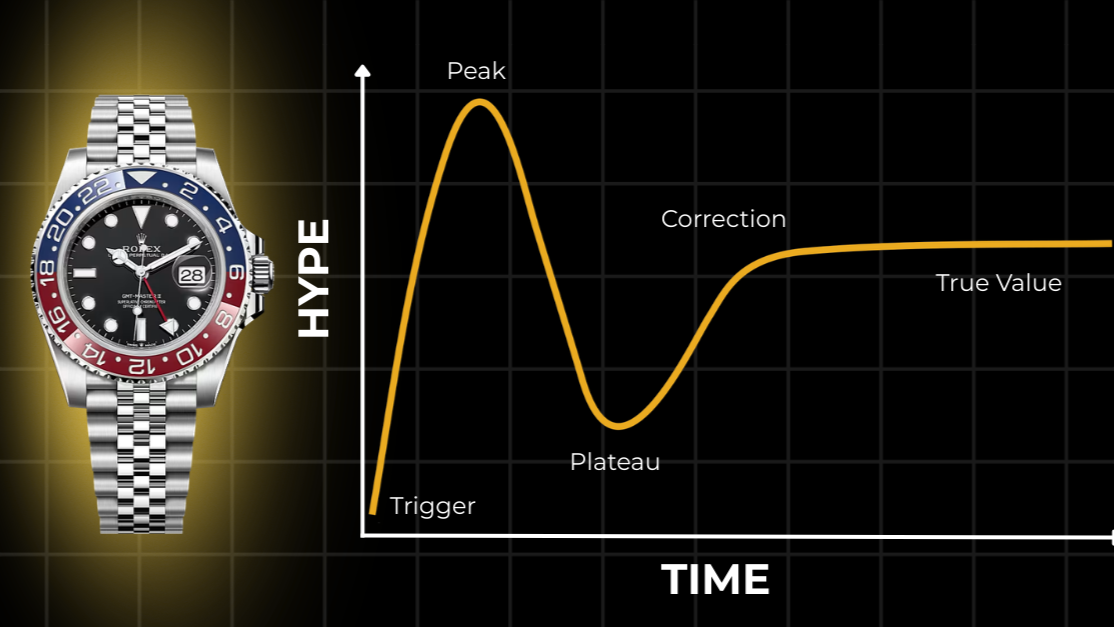
Why prices spike, plateau, and fall on the secondary market and what it means for every collector making purchase decisions today.
The secondary watch market peaked in early 2022. By mid-2025, prices had declined for more than three years across most major indices. Outside of Rolex, Patek Philippe, and Audemars Piguet, the average watch now trades roughly 25% to 35% below retail, with many brands falling further.
This same pattern has played out across nearly every major brand and every hype cycle for decades. It will happen again. Right now, in real time, it is happening to the Rolex Pepsi.
Understanding the five stages does not require industry experience. It requires knowing what to look for.
What Is a Watch Hype Cycle?
A hype cycle happens when emotional demand temporarily pushes a watch above its real value.
The same pattern appears in sneakers, cars, crypto, art, and wine. The watch market is simply easier to track because prices are public and transaction data is widely available.
The trigger is almost irrelevant:
New releases
Discontinuations
Celebrity endorsements
Color trends
Viral content
Regardless of the cause, the market tends to move through the same sequence.
Stage 1: The Trigger
First ~3 Months
When a hyped watch first hits the market, boutique inventory is extremely limited. Social media compresses the awareness cycle from months to days. Every repost, unboxing video, and wrist shot amplifies perceived scarcity before any real scarcity exists.
What the numbers show: Across tracked releases over the past decade, early market premiums typically land 30% to 100% above retail, regardless of brand. The 2025 Rolex Land-Dweller launched with a retail price around $16,500. Within weeks, unworn examples were listing on Chrono24 between roughly $35,000 and $55,000 depending on configuration, more than double retail before a single year of wear.
At this stage the premium reflects how many people heard about the watch, not how good the watch actually is.
Stage 2: The Hype Spike
Months ~3–12
This is where most buyers make the expensive mistake.
Excitement becomes belief. Buyers convince themselves the price will only go higher. Influencer coverage peaks. Mainstream media starts writing about the watch. Buyers who hesitated earlier begin paying whatever is being asked.
What the numbers show: For most tracked releases, the highest premiums occur here — not at initial launch. This is the window where watches frequently reach 2x to 3x retail. It is also the stage with the least margin for error, because prices are being driven by sentiment rather than fundamentals.
The Rolex GMT-Master II Pepsi is in this stage right now.
The watch retails around $12,000 and has been trading in the mid-$20,000s for actual transactions. Discontinuation rumors, now corroborated by WatchPro, which reported that authorized dealers were notified that no further steel Pepsi deliveries are coming, have pushed some asking prices above $30,000. That is a 150% premium on a rumor that just became real.
This is also the stage where the data becomes a trap. Prices look like they are going up. They are. But the ceiling is closer than it appears, and the downside once sentiment shifts is steep.
A simple test: Could you resell the watch tomorrow for the same price you paid? If the answer is no, you are likely in Stage 2.
Stage 3: The Plateau
Months ~12–24
Listing prices stop rising. To many observers it looks like the market found balance. It has not.
What is actually happening is that demand is slowing while supply quietly increases. Dealers who bought inventory during the hype begin moving watches through private channels, dealer groups, and off-market transactions long before those price cuts appear publicly.
The public listing price appears stable. The floor underneath it is already weakening.
The signal to watch: Listing volume increases week over week while asking prices stay flat. More watches available at the same price means fewer buyers are absorbing supply.
WatchCharts tracked this pattern clearly between mid-2022 and 2024, when Chrono24 inventory continued climbing even as buyer demand declined.
Stage 4: The Correction
Months ~24–36
Eventually the hype burns off and prices move back toward sustainable levels.
The most common mistake buyers make here is trusting listing prices instead of sold prices. Sellers are slow to accept new realities. They keep asking for peak prices while actual transactions happen well below them.
The widening gap between asking prices and executed sales is the clearest signal the correction is underway.
What the numbers show: Average corrections across tracked models run 20% to 45% off peak. Deeper resets reach 50% to 60%.
The 2022 to 2025 correction shows the full range:
The 2022 to 2025 correction
According to WatchCharts’ Mid-Year 2025 Report, 29 of 35 tracked Swiss brands showed price declines in Q2 2025, with 25 brands dropping more than 1% in a single quarter.
This was a broad market correction, not a handful of overheated references.
One rule worth following during this phase: only look at sold data, not listing data. Active listings are what sellers hope to get. Completed transactions are what the market is actually paying.
Stage 5: True Market Value
Months ~36–60+
Eventually speculation disappears. Flippers exit the market. What remains are collectors buying watches because they want them, not because they expect short-term appreciation.
What the numbers show: Prices stabilize within a relatively narrow range until something structural changes:
Genuine discontinuation
Cultural relevance
Precious-metal price movements
By mid-2025, only five brands tracked by WatchCharts showed positive price movement year-to-date:
Patek Philippe (+2.8%)
Rolex (+1.6%)
Grand Seiko (+1.6%)
Omega (+0.9%)
Cartier (+0.3%)
Each has a deep collector base that supports long-term demand independent of hype cycles.
This stage historically represents the lowest-risk entry window. Three to five years after a release or discontinuation, once speculation fades, prices tend to stabilize and volatility declines.
Where the Pepsi Fits Right Now
The Pepsi discontinuation is a useful live case study because it combines two different parts of the cycle at once.
During the COVID-era boom between 2020 and 2022, auction prices peaked above $35,000 before correcting sharply as the broader steel sports market cooled. That was a full Stage 2 through Stage 4 cycle.
The watch stabilized in the mid-$20,000s through 2024 and early 2025.
Now, with wide spread reports of discontinuation prior Watches and Wonders 2026, stage 2 has reignited. Asking prices are climbing back toward prior highs. The same watch, the same reference, is running the cycle a second time with a new trigger.
Whether this spike holds or corrects depends on one thing: whether new supply ever enters the market. A confirmed end to production with no replacement reference would support a higher floor long term. A replacement model at Watches and Wonders would almost certainly send current listing prices back down quickly.
That uncertainty is exactly what Stage 2 looks like. And it is exactly why buying into it is a timing game most buyers lose.
Four Signals That Tell You Where You Are
Before any secondary market purchase, check four indicators.
The resale test
Could you sell the watch tomorrow at the same price? If no, you are in Stage 2 or 3.
The price slope
Are recent sold prices trending up, flat, or down? The direction matters more than the current level.
Listing velocity
Is the number of available listings growing week over week while prices stay flat? That is the Stage 3 warning signal.
Time since release or discontinuation
Three to five years post-event is where Stage 5 typically establishes itself. It is also where the data most consistently supports buying.
This cycle runs on the same mechanics across every brand, every price point, and every trigger. The 2022 correction showed it at scale. The Pepsi is showing it again right now.
Sources: WatchCharts Mid-Year 2025 Update · Chrono24 H1 2025 Secondary Market Report · WatchCharts September 2025 via Quill and Pad · WatchPro Pepsi Discontinuation Confirmation March 2026 · Everest Bands Pepsi Market Analysis March 2026
— Christian Bruhn