
When we speak about Swiss watchmaking, we often speak about brands, auctions, and cities of prestige. We speak about visibility.
What we speak about far less are the places that built the structure beneath that visibility.
One of those places is Fleurier.
Most collectors outside Switzerland have never heard of it. And yet its contribution to modern horology is foundational.
For many, the symbolic center of Swiss watchmaking remains Geneva. It is associated with diplomacy, finance, auctions, and global recognition. Some may also point to La Chaux-de-Fonds, long known for its industrial watchmaking heritage.
But Fleurier operates differently.
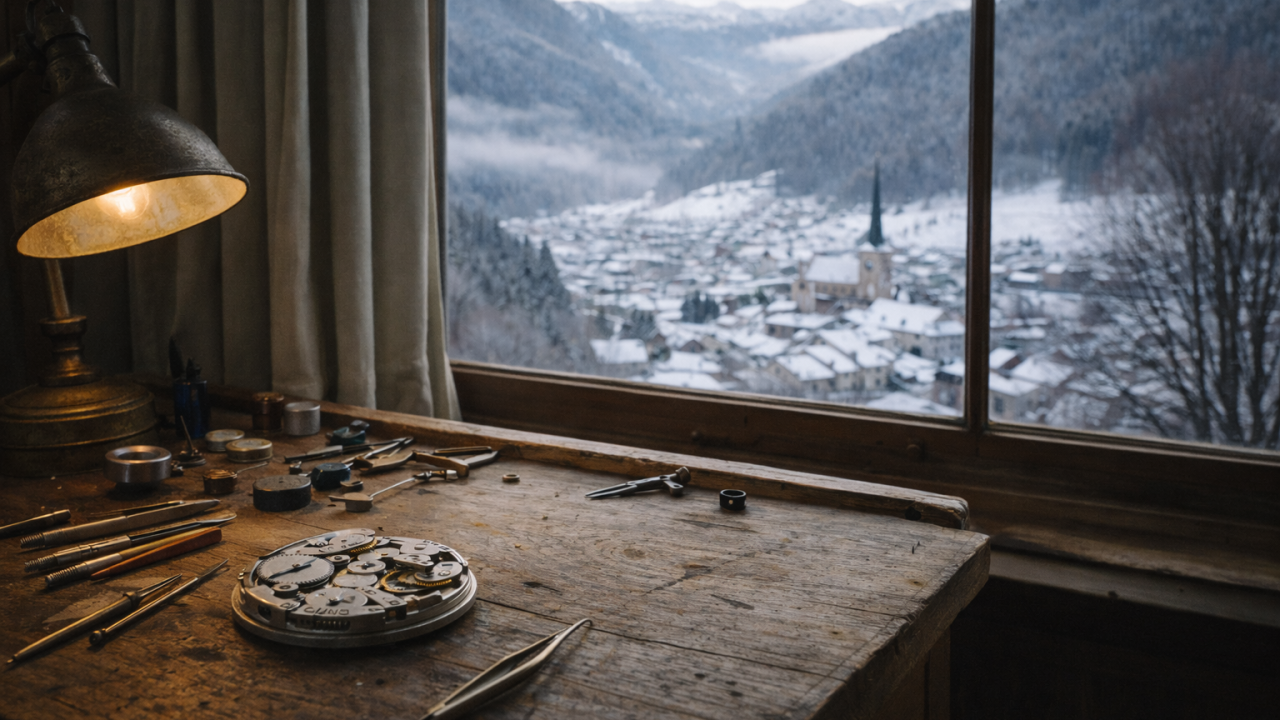
It sits in the Val-de-Travers, surrounded by landscape rather than institutions. It does not host major watch fairs. It does not position itself as a stage for spectacle. It is, above all, a place of work.
Historically, the region developed deep expertise in movement construction, precision components, dial production, and regulation. Manufacturing happened in proximity. Skills were passed across generations. Standards were preserved because they were embedded in local culture.
What the industry today markets as vertical integration was simply daily practice in valleys like this.
During the quartz crisis, when mechanical watchmaking faced existential pressure, recovery required technical resilience. Beyond branding and commercial strategy, it required communities that still believed in mechanical craft.
Fleurier contributed to that resilience. High precision manufacturing in the region strengthened the mechanical backbone of the industry. Companies such as VAUCHER MANUFACTURE FLEURIER AG developed capabilities that supported brands well beyond the valley itself.
Collectors may admire the name printed on a dial without realizing how often the discipline inside the case connects back to regions like this.
It is interesting that one of the most photographed symbols of Swiss watchmaking is L'Horloge Fleurie in Geneva. Created in 1955 as a tribute to the country’s horological heritage, it is a floral clock maintained with seasonal flowers and admired by visitors from around the world.
Despite the similarity in name, it has no connection to Fleurier. The former is symbolic and decorative. The latter is industrial and mechanical.
One represents the image of Swiss watchmaking. The other has helped sustain its structure.
Both have their place. But only one builds the movement.
Unlike Geneva, which evolved into a global symbol of prestige, Fleurier remained focused on production. It did not cultivate narrative power. It cultivated tolerances.
In modern markets, recognition tends to follow visibility. Cities that host auctions and global events dominate conversation. But conversation does not sustain horology.
Work does.
Fleurier did not give the industry spectacle. It gave it stability.
It reinforced chronometric discipline. It preserved finishing standards that require patience and time. It demonstrated that serious watchmaking depends on control of process rather than volume of marketing.
Understanding places like Fleurier changes how one looks at a mechanical watch. Attention shifts from branding to architecture, from trend to construction, from noise to structure.
Swiss watchmaking was not built only in cities of prestige. It was shaped in valleys where discipline was daily practice and humility was normal.
Fleurier may never dominate headlines.
It does not need to.
Its contribution is embedded in the structure of the industry itself.
And in watchmaking, structure is what endures.
Mohammed Almarwani,
— Mohammed Almarwani, ACIArb, CEO, AllChrono