
Apollo 13, Mechanical Time, and the Architecture of Trust
History rarely announces itself while it is unfolding. It disguises itself as procedure, calculation, restraint.
In April 1970, Apollo 13 ceased to be a mission of exploration and became an exercise in survival. An oxygen tank exploded. Power was rationed. Every calculation was reviewed with the understanding that approximation could be fatal.
To return safely to Earth, the spacecraft required a precisely timed fourteen-second engine burn. Not symbolic seconds. Measured seconds. The difference between re-entry and loss would be decided within a window smaller than a quarter of a minute.
The astronauts used a manually wound Omega Speedmaster to measure that interval.
The watch did not rescue the crew alone. Engineering discipline did. Human composure did. But the chronograph became part of the chain of responsibility. It functioned when failure carried consequence.
That is where its legitimacy begins.
In contemporary watch collecting, discussions often revolve around finishing, allocation, auction performance, or scarcity. These subjects are not trivial. They are secondary. The rarest quality in horology is not complication. It is relevance under pressure.
The Speedmaster earned that relevance in orbit.
NASA later awarded Omega the Silver Snoopy Award for its contributions to flight safety and mission success. Snoopy had long served as the agency’s symbol for quality control and mission assurance. The award was not decorative. It was institutional recognition granted under conditions where symbolism is carefully chosen.
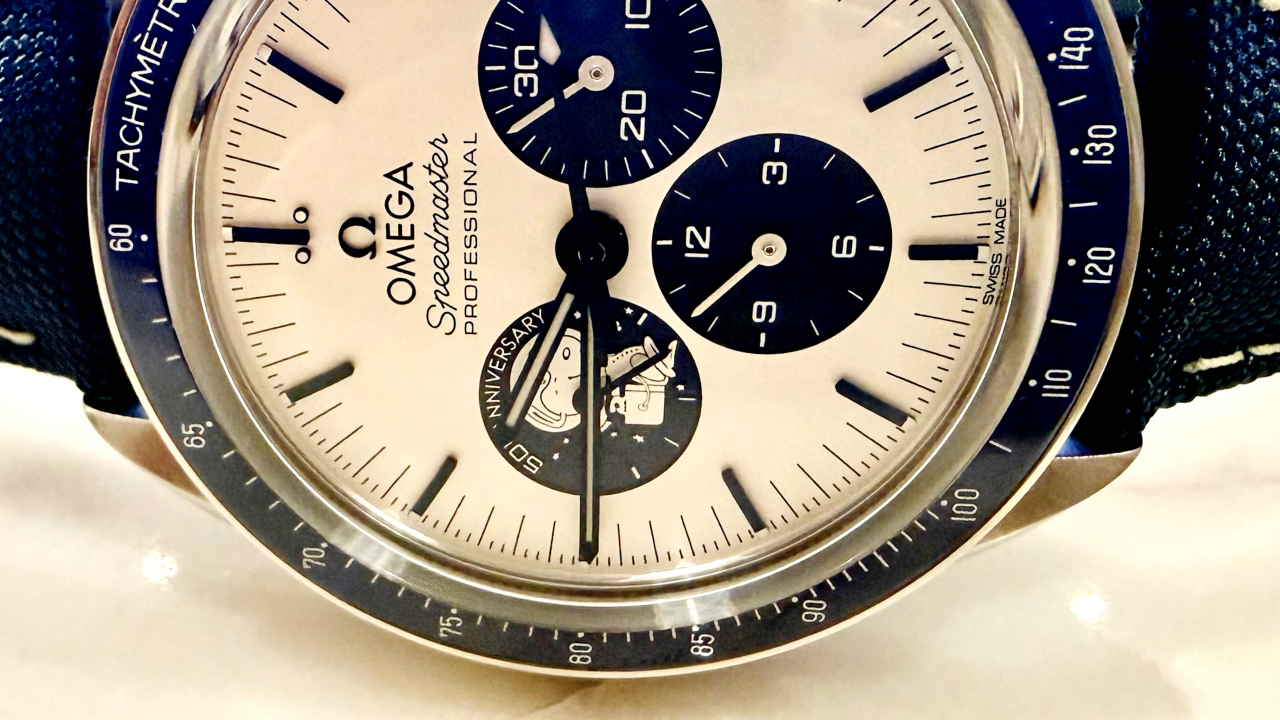
The fiftieth anniversary Silver Snoopy Award edition reflects that gravity without exaggeration.
The dial is silver, textured yet restrained. The blue ceramic bezel frames the tachymeter scale with clarity rather than celebration. At nine o’clock, Snoopy appears within the running seconds register against a dark field engraved with the anniversary inscription. The execution avoids theatricality. It remains disciplined.
Inside beats the caliber 3861, a Master Chronometer movement certified by METAS, equipped with the Co-Axial escapement and resistant to magnetic fields up to fifteen thousand gauss. It is technically modern yet architecturally faithful to the lineage that accompanied astronauts into space. Continuity is preserved without retreating into nostalgia.
The caseback introduces a controlled mechanical narrative. When the chronograph is engaged, Snoopy traverses the lunar surface inside his Command and Service Module while Earth rotates steadily in the distance. The animation is precise, mechanically linked, and executed with restraint. It exists to preserve memory, not to trivialize it.
Eyes on the Stars
Many limited editions are conceived to stimulate demand. This watch exists because demand was preceded by history. Its desirability is insulated by authenticity. Collectors instinctively distinguish between narrative constructed after the fact and narrative forged under pressure.
In my own collection, this is often the watch that draws attention first. Its popularity initially made me cautious. Watches amplified by attention frequently become diluted by it.
Yet the Silver Snoopy Award withstands scrutiny.
When I look at it, I do not see a cartoon. I see measured responsibility. Fourteen seconds once separated survival from catastrophe. A mechanical chronograph recorded those seconds with indifferent precision.
We now inhabit a world synchronized to satellites. Our devices measure time with atomic accuracy. They surpass any mechanical watch in precision, yet they lack permanence. They are replaced, updated, forgotten.
Mechanical watches endure because they represent a different relationship with time. They require participation. They demand winding. They reward attention. They embody discipline rather than automation.
Apollo 13 was not a story of spectacle. It was a story of systems functioning under stress. Engineers calculated. Astronauts executed. Instruments performed. Trust was not declared. It was tested.
The Speedmaster became trusted because it performed when conditions were hostile.
Markets will recalibrate. Technologies will advance beyond the imagination of their inventors. Preferences will shift. The language of innovation will reinvent itself.
The story of Apollo 13 will remain.
Within that story, fourteen measured seconds will continue to represent something rare: a moment when mechanical precision stood inside uncertainty and did not fail.
Eyes on the Stars
That is why the Silver Snoopy Award endures.
Not as a novelty. Not as a collectible.
But as "evidence"
— Mohammed Almarwani, ACIArb, CEO, AllChrono