
Why one of Rolex’s least discussed watches may also be one of its most intellectually complete daily wearers
There are watches that become powerful because the world agrees on them quickly.
And there are watches whose authority reveals itself more slowly, more privately, and perhaps more truthfully.
The Rolex Air-King belongs to the second category.
I have long believed that it is one of the most underrated watches in the Rolex catalogue. Not because it lacks distinction, and certainly not because it lacks heritage, but because it occupies a more demanding place in the imagination of the market. It is not a Rolex that surrenders itself immediately. It does not arrive with the same ready-made social script as some of the brand’s other references. It asks for a more attentive eye. It asks for patience. It asks to be understood on its own terms.
That is precisely why it matters.
The modern watch market tends to reward what can be read instantly. The Submariner is universally legible. The Daytona carries a mythology that extends far beyond the watch itself. The Datejust has become one of the most socially fluent objects in modern luxury. Each has earned its place. But the Air-King exists in another register. It is not a watch built around immediate consensus. It is a watch built around conviction.
That distinction is not small.
In fact, it may be one of the most important distinctions in watchmaking.
Because once a watch is no longer judged only by how loudly it signals, a different standard begins to emerge. One starts looking not only for recognition, but for coherence. Not only for prestige, but for internal logic. Not only for fame, but for design that can withstand repeated life on the wrist.
This is where the Air-King becomes deeply persuasive.
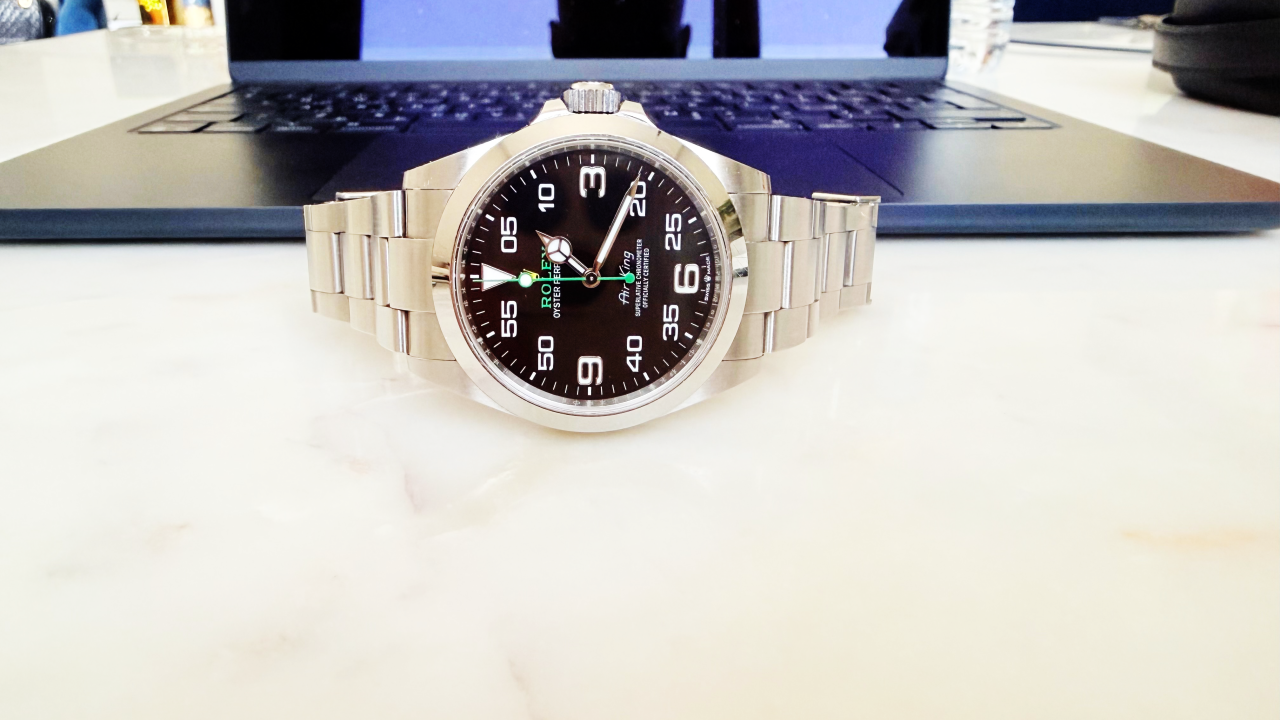
It is, in my view, one of the most purposeful dials Rolex has made in the modern era. The large 3, 6, and 9 hour markers, combined with the prominent minutes scale, give it a character that feels far closer to an instrument than to an ornament. The dial does not seem interested in visual softness. It is direct. It is precise. It has the posture of something made to orient, not merely to impress.
That quality gives the watch a certain seriousness.
It feels designed from within.
Too often, watches are praised for being iconic when what they really are is familiar. Familiarity is not the same thing as resolution. A watch can be famous without being profound. It can be admired without being fully considered. The Air-King has always interested me because it resists that easy collapse. Its identity is not accidental, and it is not decorative. Its visual language has tension in it. It contains purpose. It has enough specificity to divide opinion, and that is often where real character begins.
That is also why it works so exceptionally well as a daily wearable watch.
A true daily watch should do more than survive repetition. It should gain authority through repetition. It should continue to justify itself after novelty has disappeared. It should feel more convincing on the fiftieth wear than on the first. The Air-King does exactly that. The more one lives with it, the more the design ceases to feel unusual and begins to feel inevitable.
That, to me, is one of the highest compliments one can pay a watch.
Because inevitability is what serious design earns over time.
Rolex itself frames the Air-King through its long connection with aviation, and rightly so. The watch is immediately recognizable through its distinctive display, and that display is inseparable from the brand’s historical ties to the world of flight since the 1930s. But what is compelling is not merely the reference to aviation as a theme. It is the mentality that comes with it.
Aviation, especially in its earlier heroic age, was not just about movement. It was about direction. Discipline. Precision under pressure. Courage in conditions where error had consequences. It represented a union between technical instrument and human daring. The Air-King carries something of that spirit. Not in a theatrical way, and not through costume, but through design logic.
That is what gives the watch depth.
Its face recalls a world marked by records, achievements, and a seriousness of purpose that modern luxury too often forgets. It pays tribute to airborne adventure, yes, but more importantly, it preserves a certain relationship between function and aspiration. It reminds us that adventure once depended not on performance as spectacle, but on capability as fact.
The Air-King still feels close to that older ethic.
That is rare.
Especially now, when so many objects in the luxury world are shaped first by market appetite and only afterward by narrative.
The Air-King does not feel like that to me. It feels like a watch whose narrative and form belong to one another. It feels robust, certainly. It feels precise, as it should. But beyond those expected qualities, it also feels internally disciplined. It has an identity that has not been diluted for easy approval.
And perhaps that is why it is often underestimated.
Because the market is often kinder to watches that are easy to classify.
The Air-King resists easy classification. It is neither the most universally celebrated Rolex nor the most frequently cited. It does not sit at the center of every hierarchy people try to construct around the brand. But watches that escape simplistic hierarchy are often the ones that deserve the deepest respect. They have not been flattened by overfamiliarity. They have not been emptied by overexposure. They remain intact enough to reward real attention.
That is exactly how I have come to see the Air-King.
Not as a secondary Rolex.
Not as an eccentric outlier.
But as one of the most honest expressions in the entire Rolex line.
It is a watch with a point of view. A watch with discipline. A watch whose strength lies not in shouting its value, but in revealing it over time. It carries the authority of Rolex without depending on the most predictable symbols through which Rolex is usually consumed.
For a daily wearable watch, that matters enormously.
Because the watches we live with every day eventually tell us something not only about design, but about ourselves. They reveal what we continue to value when novelty fades. They reveal whether we are drawn merely to recognition, or to something more lasting. The Air-King, at least to me, belongs to that more lasting category.
It is one of the few Rolex watches that still feels as though it asks something of the wearer.
A sharper eye.
A quieter confidence.
A deeper appreciation for form shaped by purpose.
That is why I continue to believe it is one of the most underrated Rolexes ever made.
And why, in the end, it may also be one of the strongest daily watches the brand has ever produced.
— Mohammed Almarwani, ACIArb, CEO, AllChrono