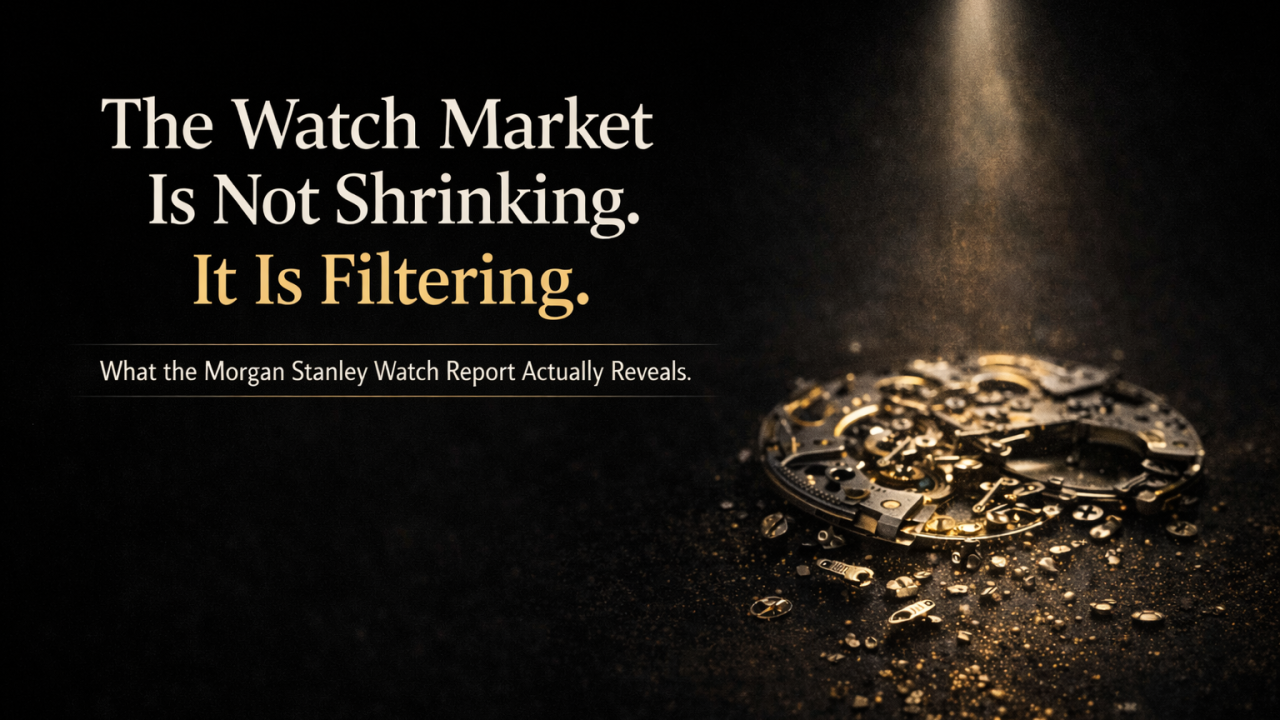
What the Morgan Stanley Watch Report Actually Reveals
Every year the Morgan Stanley and LuxeConsult watch report arrives with enormous anticipation.
Tables are studied. Rankings are debated. Movements in market share become headlines.
But the most important insights are rarely found in the rankings themselves.
They are found in the structure beneath them.
This year’s report confirms something that has been gradually shaping the watch industry for several years.
The market is not shrinking.
It is filtering.
At the top of the industry, concentration remains extraordinary.
Rolex, Patek Philippe, and Audemars Piguet continue to command a disproportionate share of the economic gravity of Swiss watchmaking. Their ability to control production, maintain desirability, and preserve long term brand discipline has created a level of market stability that very few luxury sectors experience.
This dominance is not accidental.
It is the result of decades of careful brand stewardship, controlled distribution, and design continuity.
In many ways, the modern watch industry now operates around these gravitational centers.
But the more interesting transformation is happening below them.
For years, a common narrative has circulated across the industry suggesting that the mid segment of watchmaking is disappearing.
The report quietly suggests something far more nuanced.
The mid segment is not dying.
It is becoming more selective.
The modern watch buyer is significantly more informed than previous generations. Secondary markets provide real time pricing signals. Online communities analyze movements, finishing, and design decisions with a level of scrutiny that once belonged only to specialists.
Information now travels instantly through a global network of collectors.
And that has fundamentally changed the dynamics of the market.
The middle of the industry can no longer survive on vague positioning.
Brands must offer either clear value or clear identity.
Those that do are finding momentum.
Frederique Constant is perhaps one of the most instructive examples. The brand has built momentum not through hype, but through disciplined product strategy. Complications such as the perpetual calendar and world timer have been delivered at price points that fundamentally challenge what collectors expect from Swiss watchmaking. Equally important is the brand’s extensive global distribution network, which ensures that these watches are not merely theoretical value propositions but accessible products for collectors across multiple markets.
There is also a longer horizon embedded in this strategy. Frederique Constant has become particularly appealing to younger collectors entering the world of mechanical watchmaking. Many of those collectors will grow with the brand over time, building familiarity and loyalty that often extends across decades. The watch industry has seen this dynamic before. When the first serious watch leaves a lasting impression, it often shapes collecting habits for years to come.
Raymond Weil provides another instructive case. The Millesime collection demonstrates how thoughtful design can still resonate strongly with collectors when the aesthetic language feels coherent and intentional. Its success quietly reminds the industry that restraint, when executed well, can be just as powerful as novelty.
Christopher Ward represents yet another path. By embracing a direct to consumer model while investing in increasingly ambitious mechanical projects, the brand has positioned itself as a challenger within the accessible segment. Watches such as the Bel Canto and the Twelve Loco demonstrate how technical experimentation can still capture the imagination of collectors even at relatively democratic price points. Their recent financial growth reflects a broader reality. Enthusiasm in watchmaking often follows creativity.
In other words, the mid market is not collapsing.
It is being filtered by discernment.
The brands that recognize this shift early and respond with clarity in product strategy, design identity, and distribution discipline will likely define the next decade of the mid segment.
Higher in the market, heritage continues to demonstrate its power when handled with respect.
IWC Schaffhausen’s revitalized Ingenieur illustrates this clearly. Rooted in Gerald Genta’s original architectural language, the watch reminds collectors how powerful coherent design heritage can be when it is reintroduced with clarity rather than diluted through endless reinterpretation. It is a design language that continues to resonate strongly with collectors today. I purchased one myself precisely for that reason, because it carries the authentic Genta DNA that defined the original architecture. I will likely reflect on that watch in greater detail at another time.
At the same time, the report highlights another structural pressure affecting several established brands.
Repetition eventually reaches saturation.
Even the most iconic collections cannot be expanded indefinitely without testing the patience of collectors. When price increases begin to outpace perceived innovation or mechanical value, the market inevitably responds.
OMEGA SAs recent positioning reflects this tension. The Seamaster and Speedmaster remain among the most historically significant watches ever produced, yet continuous variations combined with aggressive price escalation inevitably invite a more critical evaluation from collectors.
There is also an important geographical dimension that often receives less attention in these discussions.
Markets such as the Gulf are playing an increasingly significant role in the global watch economy. Collectors across Saudi Arabia and the wider region have long demonstrated a deep cultural appreciation for mechanical watchmaking, and their influence on the market continues to grow. Unlike purely trend driven markets, many collectors in the region approach watches through a lens of legacy, craftsmanship, and long term value.
This perspective reinforces the very trend the report hints at.
Credibility matters.
The watch industry has entered a period where the buyer is more informed, more connected, and more confident than ever before.
Collectors today are not simply purchasing objects.
They are evaluating credibility.
In many ways, the industry is entering a phase where trust infrastructure becomes just as important as product innovation. As the global market becomes more interconnected and transparent, the systems that enable collectors to transact with confidence will matter as much as the watches themselves.
And credibility is becoming the most valuable currency in modern watchmaking.
That is the deeper message inside this year’s report.
Not which brand moved up or down a ranking.
But which brands are earning the long term trust of the modern collector.
Because in a market built around mechanical permanence, trust remains the only asset that truly compounds over time.
— Mohammed Almarwani, ACIArb, CEO, AllChrono