When a Worldtimer Tells You How the World Thinks
A worldtimer is never just a complication.
It is a map of relevance.
Every city on the dial is a decision. Every omission is also a decision. Watchmaking may present the worldtimer as a practical instrument, but beneath the surface it carries something more revealing: a view of the world as the industry understands it.
That is why I have always found this complication so interesting.
Not because it tells time in different places.
Because it tells us which places are considered worth naming.
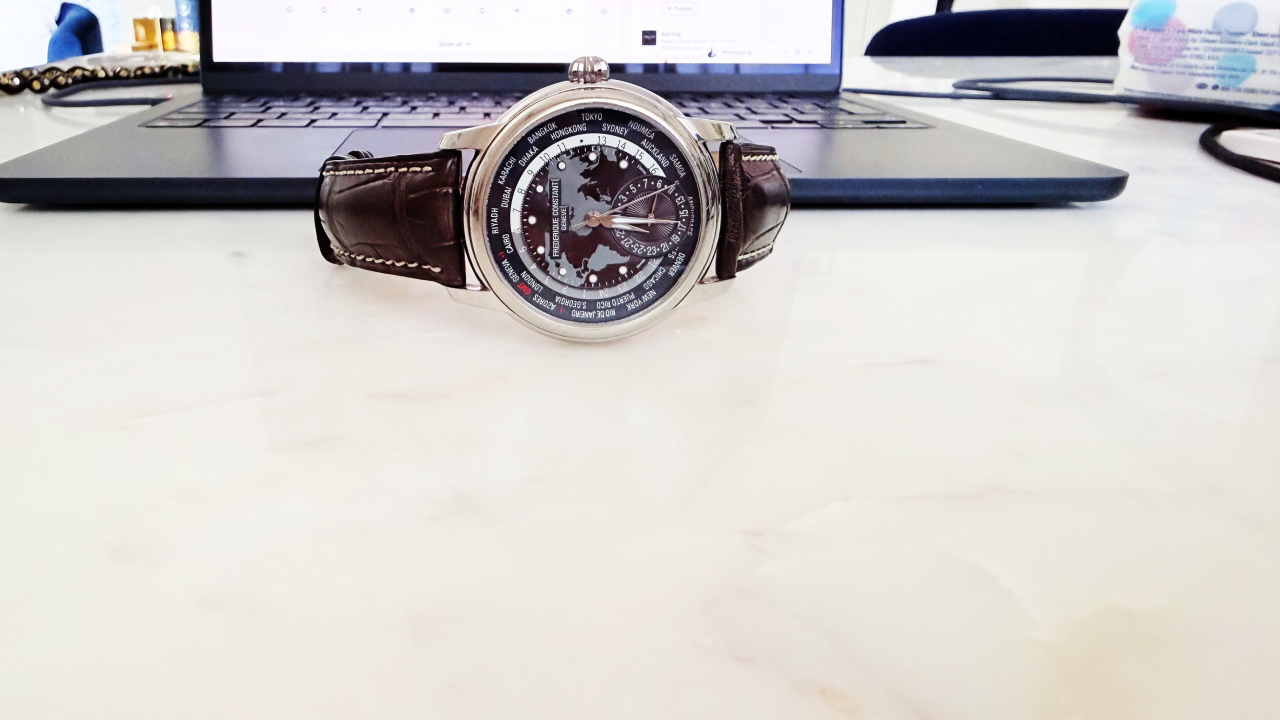
This Frédérique Constant Worldtimer Manufacture is elegant in the way the brand often is elegant. It does not shout. It does not try to intimidate the wrist. It takes a serious complication and gives it warmth, proportion, and a certain democratic dignity.
The dial has depth.
The globe gives it quiet geographical drama.
The city ring gives it the language of travel, trade, memory, and distance.
The manufacture movement gives it seriousness.
Frédérique Constant has always occupied an interesting place in watchmaking. It is not trying to be the loudest house in the room. It is trying to prove that classical watchmaking can still be generous.
That matters.
Because generosity in watchmaking is not only about price. It is about giving the collector something intellectually complete. A real movement. A meaningful complication. A design that feels considered rather than assembled for marketing.
This watch does that.
And it does it with unusual intelligence.
Frédérique Constant is elegant, but it is also smartly priced. That distinction matters because value, when done properly, is not a discount strategy. It is an industrial discipline.
There is a difference between making something cheaper and making something more intelligently available.
The first weakens the object.
The second strengthens the system around it.
I believe the transformation of Frédérique Constant became more visible after Citizen Group took over the brand. Not because the soul of Frédérique Constant disappeared, but because the structure around it became stronger.
Scale improved.
Distribution improved.
Operational confidence improved.
And yet the watches did not feel cheaper in spirit.
That is the Japanese industrial lesson at its best: scale does not have to weaken quality. When managed correctly, scale can protect quality, standardize reliability, and make good watchmaking more available without turning it into something ordinary.
This is where Frédérique Constant becomes important.
It is Swiss in language, classical in design, and increasingly supported by a disciplined global operating logic.
That combination is not accidental.
It is why a watch like this can feel serious, elegant, and attainable at the same time.
But what makes this particular example more personal, at least to me, is the presence of Riyadh on the city ring.
I will not overstate it.
This is not the same as Riyadh being permanently integrated into the standard global production of a worldtimer. It is a limited or regional expression, which makes the gesture meaningful, but not yet structural.
And that distinction matters.
A city can appear as a courtesy.
Or it can appear as an assumption.
The first is recognition.
The second is status.
For Riyadh, the deeper question is not whether it can be placed on a dial for a special edition. The deeper question is when the global watch industry begins to understand Riyadh as part of the natural architecture of the world.
Not as a regional exception.
Not as a symbolic addition.
Not as a nod to a market.
But as one of the cities through which modern relevance is increasingly being organized.
That is why worldtimers interest me. They often preserve old hierarchies long after reality has started to move. Some cities remain because the map is inherited. Others struggle to enter because the industry has not fully updated its imagination.
Yet the world does update.
Capital moves.
Collectors move.
Tourism moves.
Taste moves.
Influence moves.
And eventually, the dial must decide whether it reflects the past or recognizes the present.
Riyadh today is not merely a domestic capital. It is becoming a command point for capital, culture, logistics, entertainment, sport, tourism, and high value consumption. It sits in a country that is no longer waiting to be interpreted through regional shorthand.
This is why I resist the lazy habit of treating the Gulf as one category.
The region is not one commercial sentence. Saudi Arabia is not simply another market beside others. Its scale, geography, demographic weight, state ambition, and cultural transformation give it a different logic.
A worldtimer, at its best, should understand that.
Still, I respect what Frédérique Constant did here.
Because even when recognition arrives through a limited or regional piece, it still says something. It says that someone inside the house was paying attention. Someone understood that Riyadh belongs in the conversation.
Perhaps not yet permanently.
But visibly.
And visibility is often the first stage before permanence.
What I like most about this watch is that it allows that conversation to happen without turning itself into a political object. It remains a watch. A refined, useful, poetic watch. But like all serious objects, it carries more meaning than it first admits.
The case is traditional.
The dial is global.
The movement is visible.
The city ring is the argument.
That is the beauty of the worldtimer.
It does not only measure hours.
It measures recognition.
And one day, when Riyadh appears on worldtimers not as a regional edition, not as a special consideration, not as an exception, but as a natural part of the global dial, the watch industry will not be making a generous gesture.
It will simply be catching up with the world.
And perhaps Frédérique Constant is already showing another form of that future.
A house where Swiss horology meets Japanese scalability.
Where classical watchmaking does not lose its dignity by becoming more available.
Where scale does not erase character, but protects it.
Because when Swiss horology meets Japanese scalability, you get Frédérique Constant.
— Mohammed Almarwani, ACIArb, CEO, AllChrono